BY DAVID SINGLETON
STAFF WRITER
Published: Friday, August 8, 2008 4:29 AM EDT
Colombia-born Isabel Balsamo couldn’t decide whether to take it as a compliment or an insult.
The remark came at a meeting Balsamo attended in Wilkes-Barre in 2006 at the height of the divisive frenzy over Hazleton’s proposed anti-illegal immigration ordinance — a law aimed squarely at that city’s burgeoning Hispanic population.
“Somebody said to me, ‘Isabel, you don’t have to worry. No one would be able to tell you were Hispanic if you didn’t open your mouth,’” said Balsamo, the Hispanic outreach coordinator at King’s College. “I think it shows we still have a long way to go.”
A long way to go — and apparently not much time to get there.
New census estimates released Thursday show northeast Pennsylvania’s Hispanic population grew dramatically in 2007, spurred by a 20.5 percent surge in Luzerne County, the fastest rate in the state.
Of the other four counties in Pennsylvania that experienced double-digit growth in the number of people of Hispanic or Latino ethnicity, Lackawanna (12.5 percent), Schuylkill (10.5 percent) and Carbon (also 10.5 percent) border Luzerne. The other is Pike (10.4 percent).
Members of the region’s Hispanic community say the latest figures portend a demographic shift that is already sending ripples through the area’s social, cultural and economic fabric.
It’s also a trend that’s been accelerating throughout the decade. In Luzerne County, the Hispanic population has more than tripled since 2000, from 3,713 to an estimated 11,971 in July 2007; Lackawanna’s has more than doubled, from 2,958 to 6,002. Schuylkill County’s grew nearly 66 percent between 2000 and 2007, from 1,674 to 2,774 residents. All of these are greater than the statewide growth of 40 percent, from 397,257 to 556,132 Hispanic residents.
“It’s going to have a positive impact on the community, but people around here are going to see a lot of change,” said Alejandra Marroquin, a Catholic Social Services caseworker who is the Hispanic outreach coordinator for the Nativity of Our Lord parish in South Scranton. “They will have to be aware, they will have to be tolerant, and they will have to be understanding.”
Dr. Agapito Lopez, a retired Hazleton ophthalmologist who represents Luzerne and Lackawanna counties on the Governor’s Advisory Commission on Latino Affairs, said the growth is being driven by immigrants attracted by the availability of jobs and the region’s comparatively modest housing costs.
Most are not coming directly from their nation of origin but from other states, principally New Jersey and New York, he said. Contrary to popular belief, he said, few are here illegally.
“Most are documented or citizens who have just moved for the reasons that anybody moves,” Lopez said.
If northeast Pennsylvania is trying to turn itself around, it needs to welcome immigrants with open arms, said John Sumansky, Ph.D., chief planning officer at Misericordia University.
“Speaking as an economist, I couldn’t be happier. This region has been losing population, so it’s always good to see a population increasing rather than diminishing,” Sumansky said.
“We not only get more people, we get a more diverse population, and there is no one I know who would say that diversity is not good for the region.”
Pedro Gonzalez, executive director of the Scranton Latin Alliance, said the growth is not all migration. Some of it can be attributed to the birth of Hispanic children whose families have been here for one, two or even three generations.
“They are coming here. They are working here. They are staying here,” he said.
Another member of the governor’s advisory commission, Hazleton social worker Anna Arias, said the fatal beating of a Mexican immigrant last month in Shenandoah — a crime with alleged ethnic underpinnings — is tragic evidence of the cultural gulf between the Hispanic community and some of its neighbors.
It is something both groups have to work on, she said.
“In my heart, I believe for you to assimilate you have to feel totally, totally welcome in that culture,” Arias said. “Until we feel like we belong and until we are treated as equals, I don’t think it will happen.”
dsingleton@timesshamrock.com
Source: Standard Speaker
Tuesday, September 09, 2008


Sunday, September 07, 2008
4th Pa. teen charged in killing of immigrant
Sat Sep 6, 12:15 PM ET
POTTSVILLE, Pa. - Authorities in Pennsylvania say a fourth teenager has been charged in the fatal beating of a Mexican immigrant.
Schuylkill County prosecutors charged the teen in juvenile court Friday with aggravated assault, ethnic intimidation and other offenses. His name and age are not being released.
Three others are charged as adults in the July attack in the town of Shenandoah on 25-year-old factory worker Luis Ramirez.
Homicide charges are filed against 16-year-old Brandon Piekarsky and 17-year-old Colin Walsh. Eighteen-year-old Derrick Donchak faces aggravated assault and other charges.
A local school district has agreed to provide Piekarsky and Walsh with 12 hours of in-home education per week while the case against them is pending.
Source: Yahoo
POTTSVILLE, Pa. - Authorities in Pennsylvania say a fourth teenager has been charged in the fatal beating of a Mexican immigrant.
Schuylkill County prosecutors charged the teen in juvenile court Friday with aggravated assault, ethnic intimidation and other offenses. His name and age are not being released.
Three others are charged as adults in the July attack in the town of Shenandoah on 25-year-old factory worker Luis Ramirez.
Homicide charges are filed against 16-year-old Brandon Piekarsky and 17-year-old Colin Walsh. Eighteen-year-old Derrick Donchak faces aggravated assault and other charges.
A local school district has agreed to provide Piekarsky and Walsh with 12 hours of in-home education per week while the case against them is pending.
Source: Yahoo
Alaskans Speak (In A Frightened Whisper): Palin Is “Racist, Sexist, Vindictive, And Mean”
September 5, 2008
by Charley James –

“So Sambo beat the bitch!”
This is how Republican Vice Presidential nominee Sarah Palin described Barack Obama’s win over Hillary Clinton to political colleagues in a restaurant a few days after Obama locked up the Democratic Party presidential nomination.
According to Lucille, the waitress serving her table at the time and who asked that her last name not be used, Gov. Palin was eating lunch with five or six people when the subject of the Democrat’s primary battle came up. The governor, seemingly not caring that people at nearby tables would likely hear her, uttered the slur and then laughed loudly as her meal mates joined in appreciatively.
“It was kind of disgusting,” Lucille, who is part Aboriginal, said in a phone interview after admitting that she is frightened of being discovered telling folks in the “lower 48” about life near the North Pole.
Then, almost with a sigh, she added, “But that’s just Alaska.”
Racial and ethnic slurs may be “just Alaska” and, clearly, they are common, everyday chatter for Palin.
Besides insulting Obama with a Step-N’-Fetch-It, “darkie musical” swipe, people who know her say she refers regularly to Alaska’s Aboriginal people as “Arctic Arabs” – how efficient, lumping two apparently undesirable groups into one ugly description – as well as the more colourful “mukluks” along with the totally unimaginative “f**king Eskimo’s,” according to a number of Alaskans and Wasillians interviewed for this article.
But being openly racist is only the tip of the Palin iceberg. According to Alaskans interviewed for this article, she is also vindictive and mean. We’re talking Rove mean and Nixon vindictive.
No wonder the vast sea of white, cheering faces at the Republican Convention went wild for Sarah: They adore the type, it’s in their genetic code. So much for McCain’s pledge of a “high road” campaign; Palin is incapable of being part of one.
Tough Getting People Who Know Her to Talk
It’s not easy getting people in the 49th state to speak critically about Palin – especially people in Wasilla, where she was mayor. For one thing, with every journalist in the world calling, phone lines into Alaska have been mostly jammed since Friday; as often as not, a recording told me that “all circuits are busy” or numbers just wouldn’t ring. I should think a state that’s been made richer than God by oil could afford telephone lines and cell towers for everyone.
On a more practical level, many people in Alaska, and particularly Wasilla, are reluctant to speak or be quoted by name because they’re afraid of her as well as the state Republican Party machine. Apparently, the power elite are as mean as the winters.
“The GOP is kind of like organized crime up here,” an insurance agent in Anchorage who knows the Palin family, explained. “It’s corrupt and arrogant. They’re all rich because they do private sweetheart deals with the oil companies, and they can destroy anyone. And they will, if they have to.”
“Once Palin became mayor,” he continued, “She became part of that inner circle.”
Like most other people interviewed, he didn’t want his name used out of fear of retribution. Maybe it’s the long winter nights where you don’t see the sun for months that makes people feel as if they’re under constant danger from “the authorities.” As I interviewed residents it began sounding as if living in Alaska controlled by the state Republican Party is like living in the old Soviet Union: See nothing that’s happening, say nothing offensive, and the political commissars leave you alone. But speak out and you get disappeared into a gulag north of the Arctic Circle for who-knows-how-long.
Alright, that’s an exaggeration brought on by my getting too little sleep and building too much anger as I worked this article. But there’s ample evidence of Palin’s vindictive willingness to destroy people she sees as opponents. Just ask the Wasilla town administrator she hired before firing him because he rebelled against the way Palin demanded he do his job, or the town librarian who refused to hold the book burning Walpurgisnach Mayor Palin demanded.
Ironically, Palin was pushed into hiring the administrator by the party poobahs who helped get her elected after she got herself into trouble over a number of precipitous firings which gave rise to a recall campaign.
“People who fought her attempt to oust the librarian are on her enemies list to this day,” states Anne Kilkenny, a Wasilla resident and one of the few Alaskans willing to speak on-the-record, for attribution, about Palin. In fact, Kilkenny actually circulated an e-mail letter about Palin that was verified and printed by The Nation.
For good measure, Palin booted the Wasilla police chief from office because, she told a local newspaper, he “intimidated” her.
Running on Extreme Fringe Evangelical Views
Sarah Palin drew early attention from state GOP apparatchiks when, during her first mayoral campaign, she ran on an anti-abortion platform. Normally, political parties do not get involved in Alaskan municipal elections because they are nonpartisan. But once word of her extreme fringe evangelical views made its way to Juneau, the state capitol, state Republicans tossed some money behind her campaign.
Once in office, Palin set out to build a machine that chewed up anyone who got in her way. The good, Godly Christian turns out to be anything but.
“She’s doesn’t like different opinions and she refuses to compromise,” Kilkenny notes. “When she was mayor, she fought ideas that weren’t hers. Worse, ideas weren’t evaluated on their merits but on the basis of who proposed them.”
Sound familiar? Palin may well be Dick Cheney’s reincarnate.
Something else has a familiar Republican ring to it: Her tax policies, and a “refund surpluses but borrow for the future” attitude.
According to Kilkenny and others in Wasilla as well as Juneau, Palin reduced progressive property taxes for businesses while mayor and increased a regressive sales tax which even hits necessities such as food. The tax cuts she promoted in her St. Paul speech actually benefited large corporate property owners far more than they benefited residents. Indeed, Kilkenny insists that many Wasilla home owners actually saw their tax bill skyrocket to make up for the shortfall. Two other Wasillian’s with whom I spoke said property taxes on their modest, three bedroom homes rose during the Palin regime.
To an outsider, it would seem hard to do, but an oil-rich town with zero debt on the day she was inaugurated mayor was left saddled with $22 million of debt by the time she moved away to become governor – especially since nothing was spent on things such as improving the city’s infrastructure or building a much-needed sewage treatment plant. So what did Mayor Palin spend the taxpayer’s money on, if not fixing streets and scrubbing sewage?
For starters, she remodelled her office. Several times over, as a matter of fact.
Then Palin spent $1 million on an unnecessary, new park that no one other than the contractors and Palin seemed to want. Next, Sarah doled out more than $15 million of taxpayer money for a sports complex that she shoved through even though the city did not own clear title to the land; now, seven years later, the matter is still in litigation and lawyer fees are said to be close to at least half of the original estimated price of the facility.
She also worked hard to get voters approval of a $5.5 million bond proposal for roads that could have been built without borrowing. Anchorage may not be the center of the financial universe but, like good Republicans everywhere, Sarah Palin knows how to please Alaskan bankers and bond dealers.
For good measure, she turned Wasilla into a wasteland of big box stores and disconnected parking lots.
Sarah Barracuda
En route to the governor’s igloo, Palin managed to land what Anne Kilkenny says is the plumb political appointment in the state: Chair of Alaska’s Oil and Gas Conservation Commission (OGCC), a $122,400 per year patronage slot with no real authority to do anything other than hold meetings. She took the job despite having no background in energy issues and, as it turned out, not liking the work.
“She hated the job,” an OGCC staff member who is not authorized to speak with the news media told me. “She hated the hours and she hated what little work there was to do. But she couldn’t figure out a way to get out of the thing without offending Gov. Murkowski” and the state Republican Party regulars, some of whom were pissed off they didn’t get appointed.
But ever the opportunist, Palin quickly concocted a way. First, she waged a campaign with the local news media claiming that the position was overpaid and should be abolished – despite the fact that she lobbied Murkowski hard to get it. Then, mounting what she saw as a white horse, Palin raised a cloud of dust by resigning from the OGCC and riding away with an undeserved reputation as a “reformer.”
But when a local reporter dared to suggest that the reformer Empress has no clothes, Palin tried to get her fired.
“She came at me like I was trying to steal her kids,” said the targeted reporter, who now works for an oil company in Anchorage. “I heard she had a wild temper and vicious mean streak but it’s nothing like you can imagine until she turns it on you.”
Not surprising since some of her high school classmates still openly call her “Sarah Barracuda,” Kilkenny insists.
Still, as a Republican Party hack Palin managed to get herself elected running under the false flag of a “reformer.”
And what did she bring to the job? No legislative experience other than a city council of a village of 5,000 people, which is smaller than some high schools in Chicago. Little hands-on supervisory or managerial experience; after all, she needed to hire a city administrator to run Wasilla. No executive experience, except for almost being recalled as mayor. A philosophy of setting public policy based on one word: No.
And what has she done since winning the job?
According to Kilkenny, nothing. Well, nothing other than suggesting the state’s multi-multi-million dollar, oil-generated surplus be distributed to residents and finance future state needs by borrowing money. Gee, doesn’t that sound precisely what George Bush did with the surplus he inherited from Bill Clinton in 2001 and we all know in what great shape Bush’s economic policies left the nation.
It may explain why, when asked by reporters, including me, what she thought about Palin being picked to be McCain’s running mate, her mother-in-law replied with a sardonic, “What has Sarah done to qualify her to be vice president?” Of course, when the woman – said by many I spoke with to be well-respected in Wasilla – was running to succeed Palin as mayor, Sarah refused to endorse her, so that may explain the family tension.
As Governor, Palin gave the legislature no direction and budget guidelines, according to the chair of a legislative committee. But then she staged a huge grandstand play of line-item vetoing countless projects, calling them pork. “They were restored because of public outcry and legislative action,” the aide said. “She vetoed them mostly because she had no idea what they were or why they were important.”
But it was enough to get the McCain, who is mostly unobservant of the world around him anyway, to think Palin has a reputation as being “anti-pork”.
In fact, Juneau observers note that Palin kept her hand stuck out as far as anyone for pork ladled out by indicted Sen. Ted Stevens. She only opposed the “bridge to nowhere” after it became clear that it would be politically unwise to keep supporting it, these same insiders assert. Then, Palin fell back on her old habits and publicly humiliated him for pork-barrel politics.
As for being “ready on day one” to be commander in chief, despite the repeated public claims she’s made, the Alaska National Guard commander said that, “she has made no command decisions, other than sending some troops to help fight a few brush fires and march in parades at county fairs.”
“Sambo Beat the Bitch”
“Palin is a conniving, manipulative, a**hole,” someone who thinks these are positive traits in a governor told me, summing up Palin’s tenure in Alaska state and local politics.
“She’s a bigot, a racist, and a liar,” is the more blunt assessment of Arnold Gerstheimer who lived in Alaska until two years ago and is now a businessman in Idaho.
“Juneau is a small town; everybody knows everyone else,” he adds. “These stories about what she calls blacks and Eskimos, well, anyone not white and good looking actually, were around long before she became a glint in John McCain’s rheumy eyes. Why do I know they’re true? Because everyone who isn’t aboriginal or Indian in Alaska talks that way.”
“Sambo beat the bitch” may be everyday language up in the bush. Whether it – and the outlook, politics and worldview Palin reflects when she says such things in public – should be part of a presidential campaign is another thing altogether. The comment says as much about McCain as it does about Palin, and it says a lot of things about Americans who overlook such statements (as well as her record) and vote anyway for McCain.
Source: LA Progressive
by Charley James –
“So Sambo beat the bitch!”
This is how Republican Vice Presidential nominee Sarah Palin described Barack Obama’s win over Hillary Clinton to political colleagues in a restaurant a few days after Obama locked up the Democratic Party presidential nomination.
According to Lucille, the waitress serving her table at the time and who asked that her last name not be used, Gov. Palin was eating lunch with five or six people when the subject of the Democrat’s primary battle came up. The governor, seemingly not caring that people at nearby tables would likely hear her, uttered the slur and then laughed loudly as her meal mates joined in appreciatively.
“It was kind of disgusting,” Lucille, who is part Aboriginal, said in a phone interview after admitting that she is frightened of being discovered telling folks in the “lower 48” about life near the North Pole.
Then, almost with a sigh, she added, “But that’s just Alaska.”
Racial and ethnic slurs may be “just Alaska” and, clearly, they are common, everyday chatter for Palin.
Besides insulting Obama with a Step-N’-Fetch-It, “darkie musical” swipe, people who know her say she refers regularly to Alaska’s Aboriginal people as “Arctic Arabs” – how efficient, lumping two apparently undesirable groups into one ugly description – as well as the more colourful “mukluks” along with the totally unimaginative “f**king Eskimo’s,” according to a number of Alaskans and Wasillians interviewed for this article.
But being openly racist is only the tip of the Palin iceberg. According to Alaskans interviewed for this article, she is also vindictive and mean. We’re talking Rove mean and Nixon vindictive.
No wonder the vast sea of white, cheering faces at the Republican Convention went wild for Sarah: They adore the type, it’s in their genetic code. So much for McCain’s pledge of a “high road” campaign; Palin is incapable of being part of one.
Tough Getting People Who Know Her to Talk
It’s not easy getting people in the 49th state to speak critically about Palin – especially people in Wasilla, where she was mayor. For one thing, with every journalist in the world calling, phone lines into Alaska have been mostly jammed since Friday; as often as not, a recording told me that “all circuits are busy” or numbers just wouldn’t ring. I should think a state that’s been made richer than God by oil could afford telephone lines and cell towers for everyone.
On a more practical level, many people in Alaska, and particularly Wasilla, are reluctant to speak or be quoted by name because they’re afraid of her as well as the state Republican Party machine. Apparently, the power elite are as mean as the winters.
“The GOP is kind of like organized crime up here,” an insurance agent in Anchorage who knows the Palin family, explained. “It’s corrupt and arrogant. They’re all rich because they do private sweetheart deals with the oil companies, and they can destroy anyone. And they will, if they have to.”
“Once Palin became mayor,” he continued, “She became part of that inner circle.”
Like most other people interviewed, he didn’t want his name used out of fear of retribution. Maybe it’s the long winter nights where you don’t see the sun for months that makes people feel as if they’re under constant danger from “the authorities.” As I interviewed residents it began sounding as if living in Alaska controlled by the state Republican Party is like living in the old Soviet Union: See nothing that’s happening, say nothing offensive, and the political commissars leave you alone. But speak out and you get disappeared into a gulag north of the Arctic Circle for who-knows-how-long.
Alright, that’s an exaggeration brought on by my getting too little sleep and building too much anger as I worked this article. But there’s ample evidence of Palin’s vindictive willingness to destroy people she sees as opponents. Just ask the Wasilla town administrator she hired before firing him because he rebelled against the way Palin demanded he do his job, or the town librarian who refused to hold the book burning Walpurgisnach Mayor Palin demanded.
Ironically, Palin was pushed into hiring the administrator by the party poobahs who helped get her elected after she got herself into trouble over a number of precipitous firings which gave rise to a recall campaign.
“People who fought her attempt to oust the librarian are on her enemies list to this day,” states Anne Kilkenny, a Wasilla resident and one of the few Alaskans willing to speak on-the-record, for attribution, about Palin. In fact, Kilkenny actually circulated an e-mail letter about Palin that was verified and printed by The Nation.
For good measure, Palin booted the Wasilla police chief from office because, she told a local newspaper, he “intimidated” her.
Running on Extreme Fringe Evangelical Views
Sarah Palin drew early attention from state GOP apparatchiks when, during her first mayoral campaign, she ran on an anti-abortion platform. Normally, political parties do not get involved in Alaskan municipal elections because they are nonpartisan. But once word of her extreme fringe evangelical views made its way to Juneau, the state capitol, state Republicans tossed some money behind her campaign.
Once in office, Palin set out to build a machine that chewed up anyone who got in her way. The good, Godly Christian turns out to be anything but.
“She’s doesn’t like different opinions and she refuses to compromise,” Kilkenny notes. “When she was mayor, she fought ideas that weren’t hers. Worse, ideas weren’t evaluated on their merits but on the basis of who proposed them.”
Sound familiar? Palin may well be Dick Cheney’s reincarnate.
Something else has a familiar Republican ring to it: Her tax policies, and a “refund surpluses but borrow for the future” attitude.
According to Kilkenny and others in Wasilla as well as Juneau, Palin reduced progressive property taxes for businesses while mayor and increased a regressive sales tax which even hits necessities such as food. The tax cuts she promoted in her St. Paul speech actually benefited large corporate property owners far more than they benefited residents. Indeed, Kilkenny insists that many Wasilla home owners actually saw their tax bill skyrocket to make up for the shortfall. Two other Wasillian’s with whom I spoke said property taxes on their modest, three bedroom homes rose during the Palin regime.
To an outsider, it would seem hard to do, but an oil-rich town with zero debt on the day she was inaugurated mayor was left saddled with $22 million of debt by the time she moved away to become governor – especially since nothing was spent on things such as improving the city’s infrastructure or building a much-needed sewage treatment plant. So what did Mayor Palin spend the taxpayer’s money on, if not fixing streets and scrubbing sewage?
For starters, she remodelled her office. Several times over, as a matter of fact.
Then Palin spent $1 million on an unnecessary, new park that no one other than the contractors and Palin seemed to want. Next, Sarah doled out more than $15 million of taxpayer money for a sports complex that she shoved through even though the city did not own clear title to the land; now, seven years later, the matter is still in litigation and lawyer fees are said to be close to at least half of the original estimated price of the facility.
She also worked hard to get voters approval of a $5.5 million bond proposal for roads that could have been built without borrowing. Anchorage may not be the center of the financial universe but, like good Republicans everywhere, Sarah Palin knows how to please Alaskan bankers and bond dealers.
For good measure, she turned Wasilla into a wasteland of big box stores and disconnected parking lots.
Sarah Barracuda
En route to the governor’s igloo, Palin managed to land what Anne Kilkenny says is the plumb political appointment in the state: Chair of Alaska’s Oil and Gas Conservation Commission (OGCC), a $122,400 per year patronage slot with no real authority to do anything other than hold meetings. She took the job despite having no background in energy issues and, as it turned out, not liking the work.
“She hated the job,” an OGCC staff member who is not authorized to speak with the news media told me. “She hated the hours and she hated what little work there was to do. But she couldn’t figure out a way to get out of the thing without offending Gov. Murkowski” and the state Republican Party regulars, some of whom were pissed off they didn’t get appointed.
But ever the opportunist, Palin quickly concocted a way. First, she waged a campaign with the local news media claiming that the position was overpaid and should be abolished – despite the fact that she lobbied Murkowski hard to get it. Then, mounting what she saw as a white horse, Palin raised a cloud of dust by resigning from the OGCC and riding away with an undeserved reputation as a “reformer.”
But when a local reporter dared to suggest that the reformer Empress has no clothes, Palin tried to get her fired.
“She came at me like I was trying to steal her kids,” said the targeted reporter, who now works for an oil company in Anchorage. “I heard she had a wild temper and vicious mean streak but it’s nothing like you can imagine until she turns it on you.”
Not surprising since some of her high school classmates still openly call her “Sarah Barracuda,” Kilkenny insists.
Still, as a Republican Party hack Palin managed to get herself elected running under the false flag of a “reformer.”
And what did she bring to the job? No legislative experience other than a city council of a village of 5,000 people, which is smaller than some high schools in Chicago. Little hands-on supervisory or managerial experience; after all, she needed to hire a city administrator to run Wasilla. No executive experience, except for almost being recalled as mayor. A philosophy of setting public policy based on one word: No.
And what has she done since winning the job?
According to Kilkenny, nothing. Well, nothing other than suggesting the state’s multi-multi-million dollar, oil-generated surplus be distributed to residents and finance future state needs by borrowing money. Gee, doesn’t that sound precisely what George Bush did with the surplus he inherited from Bill Clinton in 2001 and we all know in what great shape Bush’s economic policies left the nation.
It may explain why, when asked by reporters, including me, what she thought about Palin being picked to be McCain’s running mate, her mother-in-law replied with a sardonic, “What has Sarah done to qualify her to be vice president?” Of course, when the woman – said by many I spoke with to be well-respected in Wasilla – was running to succeed Palin as mayor, Sarah refused to endorse her, so that may explain the family tension.
As Governor, Palin gave the legislature no direction and budget guidelines, according to the chair of a legislative committee. But then she staged a huge grandstand play of line-item vetoing countless projects, calling them pork. “They were restored because of public outcry and legislative action,” the aide said. “She vetoed them mostly because she had no idea what they were or why they were important.”
But it was enough to get the McCain, who is mostly unobservant of the world around him anyway, to think Palin has a reputation as being “anti-pork”.
In fact, Juneau observers note that Palin kept her hand stuck out as far as anyone for pork ladled out by indicted Sen. Ted Stevens. She only opposed the “bridge to nowhere” after it became clear that it would be politically unwise to keep supporting it, these same insiders assert. Then, Palin fell back on her old habits and publicly humiliated him for pork-barrel politics.
As for being “ready on day one” to be commander in chief, despite the repeated public claims she’s made, the Alaska National Guard commander said that, “she has made no command decisions, other than sending some troops to help fight a few brush fires and march in parades at county fairs.”
“Sambo Beat the Bitch”
“Palin is a conniving, manipulative, a**hole,” someone who thinks these are positive traits in a governor told me, summing up Palin’s tenure in Alaska state and local politics.
“She’s a bigot, a racist, and a liar,” is the more blunt assessment of Arnold Gerstheimer who lived in Alaska until two years ago and is now a businessman in Idaho.
“Juneau is a small town; everybody knows everyone else,” he adds. “These stories about what she calls blacks and Eskimos, well, anyone not white and good looking actually, were around long before she became a glint in John McCain’s rheumy eyes. Why do I know they’re true? Because everyone who isn’t aboriginal or Indian in Alaska talks that way.”
“Sambo beat the bitch” may be everyday language up in the bush. Whether it – and the outlook, politics and worldview Palin reflects when she says such things in public – should be part of a presidential campaign is another thing altogether. The comment says as much about McCain as it does about Palin, and it says a lot of things about Americans who overlook such statements (as well as her record) and vote anyway for McCain.
Source: LA Progressive
Thursday, September 04, 2008
ACLU sues to halt RI governor's immigration order
By RAY HENRY
Associated Press Writer
A civil rights group filed a lawsuit Wednesday seeking to block Gov. Don Carcieri from enforcing an executive order requiring private employers to electronically check the immigration status of new hires.
The lawsuit, filed by the state branch of the American Civil Liberties Union, challenges an executive order that Carcieri signed in March to clamp down on illegal immigration.
Carcieri's order requires state police and prison officials to identify illegal immigrants for possible deportation. It also forces state agencies and companies doing business with the state to use a federal database to check the immigration status of new employees. Companies that refuse to comply could lose their state contracts.
The ACLU argues that the database, E-Verify, disproportionately identifies foreign-born employees as ineligible to work and that the database could encourage employers to discriminate against workers who appear foreign.
A 2007 report commissioned by the U.S. Department of Homeland Security showed 96 percent of people claiming to be U.S. citizens were cleared by the database on the first try. But the report said 3 percent of foreign-born workers with the right to work in the U.S. were erroneously rejected by the E-Verify system, compared with .1 percent of U.S. citizens born here. The report cautioned that the error rates cannot be fixed quickly.
The lawsuit accuses Carcieri of violating the state constitution by interfering with existing contracts and by enforcing an executive order that conflicts with purchasing laws adopted by the General Assembly. It also accuses Carcieri of failing to hold a public hearing about the new rules as required by law.
Carcieri spokeswoman Amy Kempe said the governor was within his legal authority to require state contractors to use the database. She said the ACLU's lawsuit lacked merit and called it an attempt to meddle with Carcieri's ability to enforce federal law.
The governor has said the estimated 20,000 to 40,000 illegal immigrants in Rhode Island are a financial drain on schools, hospitals and state government. His order sparked a raucous debate over illegal immigration in Rhode Island.
Clergy, civil rights advocates and Hispanic leaders have urged Carcieri to rescind the order, saying it could lead to racial profiling and discourage illegal immigrants from contacting police if they are victimized or witness a crime.
Source: KansasCity
Associated Press Writer
A civil rights group filed a lawsuit Wednesday seeking to block Gov. Don Carcieri from enforcing an executive order requiring private employers to electronically check the immigration status of new hires.
The lawsuit, filed by the state branch of the American Civil Liberties Union, challenges an executive order that Carcieri signed in March to clamp down on illegal immigration.
Carcieri's order requires state police and prison officials to identify illegal immigrants for possible deportation. It also forces state agencies and companies doing business with the state to use a federal database to check the immigration status of new employees. Companies that refuse to comply could lose their state contracts.
The ACLU argues that the database, E-Verify, disproportionately identifies foreign-born employees as ineligible to work and that the database could encourage employers to discriminate against workers who appear foreign.
A 2007 report commissioned by the U.S. Department of Homeland Security showed 96 percent of people claiming to be U.S. citizens were cleared by the database on the first try. But the report said 3 percent of foreign-born workers with the right to work in the U.S. were erroneously rejected by the E-Verify system, compared with .1 percent of U.S. citizens born here. The report cautioned that the error rates cannot be fixed quickly.
The lawsuit accuses Carcieri of violating the state constitution by interfering with existing contracts and by enforcing an executive order that conflicts with purchasing laws adopted by the General Assembly. It also accuses Carcieri of failing to hold a public hearing about the new rules as required by law.
Carcieri spokeswoman Amy Kempe said the governor was within his legal authority to require state contractors to use the database. She said the ACLU's lawsuit lacked merit and called it an attempt to meddle with Carcieri's ability to enforce federal law.
The governor has said the estimated 20,000 to 40,000 illegal immigrants in Rhode Island are a financial drain on schools, hospitals and state government. His order sparked a raucous debate over illegal immigration in Rhode Island.
Clergy, civil rights advocates and Hispanic leaders have urged Carcieri to rescind the order, saying it could lead to racial profiling and discourage illegal immigrants from contacting police if they are victimized or witness a crime.
Source: KansasCity
Monday, September 01, 2008
Justice for the family of Luis Eduardo Ramirez
First report - July 14, 2008
Man injured in Shenandoah fight dies (Republican Herald)
Shenandoah police are conducting interviews this afternoon in an effort to uncover the details of a brawl Saturday night in the borough that left one man dead from his injuries.
Luis Ramirez, 25, of Shenandoah, died Monday morning at Geisinger Medical Center, Danville, of injuries he sustained Saturday night in a fight near Vine and Lloyd streets, a hospital representative confirmed Monday afternoon.
Police have not yet filed charges against anyone for the fight.
More details, and beginning signs of a cover-up - July 15, 2008
SHENANDOAH — A 25-year-old father of three with roots in Mexico died Monday morning from injuries he suffered in an altercation near Vine Street Park on Saturday night, an incident some say was racially motivated.
Luis Ramirez of 15 N. Main St., in the United States illegally, died at 6:30 a.m. at Geisinger Medical Center, Danville, where he was taken for treatment after suffering severe head injuries near Vine and Lloyd streets, Shenandoah police Lt. William Moyer said.Eileen Burke, a retired Philadelphia police officer who lives near the scene, said about the time of the beating she heard someone shouting “You tell all your Mexican friends to get out of town.”
“We saw a bunch of kids walking away and screaming things like ... ‘Go back to Mexico.’ We called the police,” said Arielle Garcia, 17, a friend of Ramirez who was at the scene.
Police said they are not commenting on the assailants’ motivation until interviews are complete.
Six Shenandoah juveniles, five of whom are Shenandoah Valley High School students, were being interviewed, along with neighbors in the area and friends of the victim, according to Moyer.
“We talked to a lot of people (Sunday) and we’re doing more interviews now,” he said Monday afternoon.
When the autopsy results are obtained, Moyer said police will discuss the case with Schuylkill County District Attorney James P. Goodman to determine what, if any, charges will be filed against those involved.
Moyer said an autopsy will be conducted today at Lehigh Valley Hospital, Allentown, to determine the cause and manner of Ramirez’s death. Moyer said until then, the incident is being treated as an assault, but it could be upgraded to a homicide or manslaughter.
Garcia said she and her husband, Victor Garcia-Cruz, 21, dropped Ramirez off near Vine Street Park just before the incident.
“He was with us all day,” Garcia said. “He told us to drop him off there and he would walk the rest of the way home. He didn’t want us to waste gas.”
Garcia said the two were on their way home when Ramirez called her on his cell phone.“He told us to come back that a group of kids were yelling things at him and following him,” Garcia said.
Burke said she heard screaming about 11:30 p.m. Saturday.
“With the park across the street, I hear screaming all the time, but I turned down the air conditioning so I could hear what was going on and I could see kids going back and forth and a girl was screaming ‘Please stop hitting him,’ ” Burke said. “I called 911 to get an ambulance. There seemed to be too many kids around and I thought I’d better be safe than sorry. When I got out the front door, there was one kid running down the pavement. I heard a thud and the kid ran past again.”
Garcia said when she arrived at the scene, a boy and Ramirez were fighting.“They were close together like they were wrestling,” Garcia said. “They started pounding him by my truck. The next thing I knew, Caballo (Ramirez’s nickname) was on the ground. Someone stepped on his chest, we went down on the ground to him and just I saw a foot kick him in the head.”
Ramirez’s fiance, Crystal Dillman, 24, said Ramirez was wearing a medallion on his chest and when the person stepped on his chest, the medallion pressed into his flesh.
“You could see the imprint of the medallion in his chest at the hospital,” she said.
Dillman said she believes the beating was racially motivated.
“I know they did this because they don’t like the color of his skin,” Dillman said. “Now his children are going to grow up angry, knowing their father was killed because of his race, or nationality, or color, or whatever it was that bothered these people about him.”
“He was a good guy, a terrific father,” Dillman said. “Everyone who knew him loved him.”
Ramirez and Dillman have three children, Anjelina, 3, Kiara, 2, and Eduardo, 11 months.
Dillman said Ramirez worked to provide for his family.“He worked two jobs to give his children the life he never had,” she said.
She said Ramirez had been in the country for six years.
“It’s heartbreaking and sad,” Moyer said. “It’s a tragedy.”
Mary Gualtier, who lives on Penn Street near the scene, said she woke up to see one or two of the suspects getting into a car.
“I don’t know why no one stopped it,” she said.
Michael Burke, who has lived near the park for about 20 years, said illegal activities are becoming more common.
“It is horrible in this town anymore,” he said. “I know the cops are doing the best they can, but there is so much going on they can’t keep control of it.”
Debra Navarrete said she believes violence is on the rise again in Shenandoah.
“I was raised in the ’70s when things like fighting and trouble happened all the time. I thought that reputation has died out,” she said.
Borough Councilman Leo Pietkiewicz said the incident affects many people.
“One life is lost and other lives are ruined,” he said.
The last homicide in Shenandoah was June 20, 2004, on White Street. Police charged Kelly Hernandez with killing her husband, Jose Hernandez, 27, by stabbing him in the chest while their three children slept upstairs.
Still no arrests, the DA takes over the case - July 25, 2008
DA, state police will investigate Shenandoah beating death (Standard Speaker)
The homicide investigation into the beating death of a Shenandoah man will be conducted by the district attorney’s office and Pennsylvania State Police, Schuylkill County District Attorney James P. Goodman said Tuesday.
“The sooner they get involved, the better it is,” Shenandoah Mayor Thomas F. O’Neill Jr. said, hoping racial tensions in Shenandoah will diffuse when charges are filed.
No charges have yet been filed in relation to the death of Luis Eduardo Ramirez Zavala, 25, of 15 N. Main St., who died the morning of July 14 from injuries he suffered in an altercation near the Vine Street Park on July 12. Juveniles have been interviewed in relation to the case, including Shenandoah Valley High School football players.
At a Shenandoah Borough Council meeting Monday night, resident Jahaad Baker, 24, said there is racial tension in the town, and asked why no charges had been pressed.
“I’m sure there’s some uneasiness, people want something to be done,” Goodman said Tuesday. “I just assure the public that it’s being fully investigated and the appropriate charges will be filed.”
Goodman said interviews had been conducted “all around the clock” on Monday and Tuesday, but he could not comment more until the investigation had been completed.
O’Neill said he believes the sooner charges are filed the better it would be to ease tension in the community, but urged residents to remember the circumstances of the case make it difficult.
“The public perception, as far as certain individuals being concerned, they feel that as far as nothing is being said and nothing being done is there’s a cover-up, and that’s not the case,” O’Neill said. “The juveniles and their families must be protected until everything is resolved.”
O’Neill said that unfounded concerns about racial tension have been hurtful to the community. Rumors of a retaliation attack during two festivals last weekend meant Our Lady of Mount Carmel’s 94th bazaar, for which O’Neill is treasurer, had the lowest attendance it’s ever had, O’Neill said.
“It’s just that perception is out there, and perception becomes reality,” O’Neill said of the effect of town gossip. O’Neill said friends of his grandchildren were supposed to help with the festival, but their parents were afraid something would happen and would not allow them to go out.
There were no reports of violence at the festival.
O’Neill said he hopes these kinds of anxieties will disappear when charges are filed.
Although O’Neill said he does not believe the crime was racially motivated, he did say he would like to see the Hispanic community become more involved with the town instead of remaining insulated, particularly in this difficult time.
For example, O’Neill said he’s spoken to the town chamber of commerce and Downtown Shenandoah Inc. about getting Hispanic business owners more involved.
O’Neill said he would like to see more people in Shenandoah look at the town’s diversity in a positive light, rather than an inflammatory one.
“I got a nasty phone call left on my answering machine: ‘Shenandoah, they’re a bunch of bigots.’ We’re the only community I’m aware of that has a Heritage Day,” O’Neill said. “That’s hurtful.”
Suspects arrested - Today, July 25, 2008
3 Pa. teens charged in fatal attack on immigrant (The Evening Sun)
PORT CARBON, Pa.—Three white teens were charged Friday in what officials said was an epithet-filled fatal beating of a Mexican immigrant in a small Northeastern Pennsylvania coal town.
Brandon J. Piekarsky, 16, and Colin J. Walsh, 17, were charged as adults with homicide and ethnic intimidation in the death of Luis Ramirez. Derrick M. Donchak, 18, was charged with aggravated assault and ethnic intimidation.
Additional charges are expected in the case that has roiled Shenandoah, the small, economically depressed town where the attack occurred and police have reported friction between whites and a growing Hispanic population.
"As a result of this crime, a young man has lost his life, many other lives have been devastated, and the borough of Shenandoah has been filled with tensions between many ethnic groups," Schuylkill County District Attorney James Goodman said.
Ramirez, 25, who was in the country illegally, was beaten July 12 during a confrontation with a group of youths in a park. Authorities said the suspects used ethnic slurs during the fight, but declined to say whether Ramirez's ethnicity was the motive.
The suspects, all Shenandoah residents, played football at Shenandoah Valley High School; Donchak, now enrolled at Bloomsburg University, was the quarterback last season. He declined comment after the arraignment, but lawyers for Piekarsky and Walsh said there was no evidence to support the homicide charges.
According to a police affidavit, the defendants and three 17-year-olds were drinking alcohol in a wooded area of Shenandoah, then went to a block party sponsored by the borough's Polish American Fire Co. After leaving the party around 11 p.m., the group walked toward a park, where they encountered Ramirez and a teenage girl.
The youths goaded Ramirez and the girl, saying, "You should get out of this neighborhood" and "Get your Mexican boyfriend out of here," documents said.
After Ramirez and the girl began walking away, someone yelled an ethnic slur at him, court documents said. He responded, "What's your problem?"
A fight ensued, during which police said Walsh punched Ramirez in the face. The victim fell and hit his head on the street, leaving him unconscious, after which Piekarsky kicked him in the head, police said.
The suspects fled the scene; Ramirez underwent surgery but died about 30 hours later.
Crystal Dillman, the victim's 24-year-old fiancee, who is white and grew up in Shenandoah, said Friday that Ramirez was walking her sister to a friend's house that night.
"He was just trying to be a good person, making sure she got (there) safe," said Dillman, adding she was relieved the charges include ethnic intimidation.
She says Ramirez was often called derogatory names, including "dirty Mexican," and told to return to his homeland. Similar insults have been hurled at their children, ages 2 and 11 months, she said.
"I plan on moving out of this town as fast as I can. Not because I'm scared. I just don't want to see my children have to deal with what their father dealt with," Dillman said.
Following the arraignment, lawyers for Piekarsky and Walsh said their clients are not guilty and that they would try to have the case removed to juvenile court.
Roger Laguna, Walsh's lawyer, said the police affidavit "pretty much describes chaos, and what you have then after the fact is somebody trying to sort through that and attribute certain acts to certain individuals."
He said that although slurs might have been used, the fight was not motivated by ethnicity.
"I think any time there's a fight and any time you have one ethnic group fighting another, there's going to be racial slurs," he said. "I've seen that since I was a kid on a playground 20 years ago, but they never called it ethnic intimidation until very recently."
Frederick Fanelli, Piekarsky's lawyer, said he is "surprised and disappointed" that his client faces a homicide charge, attributing Ramirez's death to a "street fight that ended tragically."
Goodman said a fourth teen will be charged as a juvenile with aggravated assault and ethnic intimidation and that charges also will be filed against a man who provided alcohol to the defendants hours before the attack.
Piekarsky and Walsh were detained without bail. Donchak was held in lieu of $75,000 bond.
Source: RaidReport
Man injured in Shenandoah fight dies (Republican Herald)
Shenandoah police are conducting interviews this afternoon in an effort to uncover the details of a brawl Saturday night in the borough that left one man dead from his injuries.
Luis Ramirez, 25, of Shenandoah, died Monday morning at Geisinger Medical Center, Danville, of injuries he sustained Saturday night in a fight near Vine and Lloyd streets, a hospital representative confirmed Monday afternoon.
Police have not yet filed charges against anyone for the fight.
More details, and beginning signs of a cover-up - July 15, 2008
SHENANDOAH — A 25-year-old father of three with roots in Mexico died Monday morning from injuries he suffered in an altercation near Vine Street Park on Saturday night, an incident some say was racially motivated.
Luis Ramirez of 15 N. Main St., in the United States illegally, died at 6:30 a.m. at Geisinger Medical Center, Danville, where he was taken for treatment after suffering severe head injuries near Vine and Lloyd streets, Shenandoah police Lt. William Moyer said.Eileen Burke, a retired Philadelphia police officer who lives near the scene, said about the time of the beating she heard someone shouting “You tell all your Mexican friends to get out of town.”
“We saw a bunch of kids walking away and screaming things like ... ‘Go back to Mexico.’ We called the police,” said Arielle Garcia, 17, a friend of Ramirez who was at the scene.
Police said they are not commenting on the assailants’ motivation until interviews are complete.
Six Shenandoah juveniles, five of whom are Shenandoah Valley High School students, were being interviewed, along with neighbors in the area and friends of the victim, according to Moyer.
“We talked to a lot of people (Sunday) and we’re doing more interviews now,” he said Monday afternoon.
When the autopsy results are obtained, Moyer said police will discuss the case with Schuylkill County District Attorney James P. Goodman to determine what, if any, charges will be filed against those involved.
Moyer said an autopsy will be conducted today at Lehigh Valley Hospital, Allentown, to determine the cause and manner of Ramirez’s death. Moyer said until then, the incident is being treated as an assault, but it could be upgraded to a homicide or manslaughter.
Garcia said she and her husband, Victor Garcia-Cruz, 21, dropped Ramirez off near Vine Street Park just before the incident.
“He was with us all day,” Garcia said. “He told us to drop him off there and he would walk the rest of the way home. He didn’t want us to waste gas.”
Garcia said the two were on their way home when Ramirez called her on his cell phone.“He told us to come back that a group of kids were yelling things at him and following him,” Garcia said.
Burke said she heard screaming about 11:30 p.m. Saturday.
“With the park across the street, I hear screaming all the time, but I turned down the air conditioning so I could hear what was going on and I could see kids going back and forth and a girl was screaming ‘Please stop hitting him,’ ” Burke said. “I called 911 to get an ambulance. There seemed to be too many kids around and I thought I’d better be safe than sorry. When I got out the front door, there was one kid running down the pavement. I heard a thud and the kid ran past again.”
Garcia said when she arrived at the scene, a boy and Ramirez were fighting.“They were close together like they were wrestling,” Garcia said. “They started pounding him by my truck. The next thing I knew, Caballo (Ramirez’s nickname) was on the ground. Someone stepped on his chest, we went down on the ground to him and just I saw a foot kick him in the head.”
Ramirez’s fiance, Crystal Dillman, 24, said Ramirez was wearing a medallion on his chest and when the person stepped on his chest, the medallion pressed into his flesh.
“You could see the imprint of the medallion in his chest at the hospital,” she said.
Dillman said she believes the beating was racially motivated.
“I know they did this because they don’t like the color of his skin,” Dillman said. “Now his children are going to grow up angry, knowing their father was killed because of his race, or nationality, or color, or whatever it was that bothered these people about him.”
“He was a good guy, a terrific father,” Dillman said. “Everyone who knew him loved him.”
Ramirez and Dillman have three children, Anjelina, 3, Kiara, 2, and Eduardo, 11 months.
Dillman said Ramirez worked to provide for his family.“He worked two jobs to give his children the life he never had,” she said.
She said Ramirez had been in the country for six years.
“It’s heartbreaking and sad,” Moyer said. “It’s a tragedy.”
Mary Gualtier, who lives on Penn Street near the scene, said she woke up to see one or two of the suspects getting into a car.
“I don’t know why no one stopped it,” she said.
Michael Burke, who has lived near the park for about 20 years, said illegal activities are becoming more common.
“It is horrible in this town anymore,” he said. “I know the cops are doing the best they can, but there is so much going on they can’t keep control of it.”
Debra Navarrete said she believes violence is on the rise again in Shenandoah.
“I was raised in the ’70s when things like fighting and trouble happened all the time. I thought that reputation has died out,” she said.
Borough Councilman Leo Pietkiewicz said the incident affects many people.
“One life is lost and other lives are ruined,” he said.
The last homicide in Shenandoah was June 20, 2004, on White Street. Police charged Kelly Hernandez with killing her husband, Jose Hernandez, 27, by stabbing him in the chest while their three children slept upstairs.
Still no arrests, the DA takes over the case - July 25, 2008
DA, state police will investigate Shenandoah beating death (Standard Speaker)
The homicide investigation into the beating death of a Shenandoah man will be conducted by the district attorney’s office and Pennsylvania State Police, Schuylkill County District Attorney James P. Goodman said Tuesday.
“The sooner they get involved, the better it is,” Shenandoah Mayor Thomas F. O’Neill Jr. said, hoping racial tensions in Shenandoah will diffuse when charges are filed.
No charges have yet been filed in relation to the death of Luis Eduardo Ramirez Zavala, 25, of 15 N. Main St., who died the morning of July 14 from injuries he suffered in an altercation near the Vine Street Park on July 12. Juveniles have been interviewed in relation to the case, including Shenandoah Valley High School football players.
At a Shenandoah Borough Council meeting Monday night, resident Jahaad Baker, 24, said there is racial tension in the town, and asked why no charges had been pressed.
“I’m sure there’s some uneasiness, people want something to be done,” Goodman said Tuesday. “I just assure the public that it’s being fully investigated and the appropriate charges will be filed.”
Goodman said interviews had been conducted “all around the clock” on Monday and Tuesday, but he could not comment more until the investigation had been completed.
O’Neill said he believes the sooner charges are filed the better it would be to ease tension in the community, but urged residents to remember the circumstances of the case make it difficult.
“The public perception, as far as certain individuals being concerned, they feel that as far as nothing is being said and nothing being done is there’s a cover-up, and that’s not the case,” O’Neill said. “The juveniles and their families must be protected until everything is resolved.”
O’Neill said that unfounded concerns about racial tension have been hurtful to the community. Rumors of a retaliation attack during two festivals last weekend meant Our Lady of Mount Carmel’s 94th bazaar, for which O’Neill is treasurer, had the lowest attendance it’s ever had, O’Neill said.
“It’s just that perception is out there, and perception becomes reality,” O’Neill said of the effect of town gossip. O’Neill said friends of his grandchildren were supposed to help with the festival, but their parents were afraid something would happen and would not allow them to go out.
There were no reports of violence at the festival.
O’Neill said he hopes these kinds of anxieties will disappear when charges are filed.
Although O’Neill said he does not believe the crime was racially motivated, he did say he would like to see the Hispanic community become more involved with the town instead of remaining insulated, particularly in this difficult time.
For example, O’Neill said he’s spoken to the town chamber of commerce and Downtown Shenandoah Inc. about getting Hispanic business owners more involved.
O’Neill said he would like to see more people in Shenandoah look at the town’s diversity in a positive light, rather than an inflammatory one.
“I got a nasty phone call left on my answering machine: ‘Shenandoah, they’re a bunch of bigots.’ We’re the only community I’m aware of that has a Heritage Day,” O’Neill said. “That’s hurtful.”
Suspects arrested - Today, July 25, 2008
3 Pa. teens charged in fatal attack on immigrant (The Evening Sun)
PORT CARBON, Pa.—Three white teens were charged Friday in what officials said was an epithet-filled fatal beating of a Mexican immigrant in a small Northeastern Pennsylvania coal town.
Brandon J. Piekarsky, 16, and Colin J. Walsh, 17, were charged as adults with homicide and ethnic intimidation in the death of Luis Ramirez. Derrick M. Donchak, 18, was charged with aggravated assault and ethnic intimidation.
Additional charges are expected in the case that has roiled Shenandoah, the small, economically depressed town where the attack occurred and police have reported friction between whites and a growing Hispanic population.
"As a result of this crime, a young man has lost his life, many other lives have been devastated, and the borough of Shenandoah has been filled with tensions between many ethnic groups," Schuylkill County District Attorney James Goodman said.
Ramirez, 25, who was in the country illegally, was beaten July 12 during a confrontation with a group of youths in a park. Authorities said the suspects used ethnic slurs during the fight, but declined to say whether Ramirez's ethnicity was the motive.
The suspects, all Shenandoah residents, played football at Shenandoah Valley High School; Donchak, now enrolled at Bloomsburg University, was the quarterback last season. He declined comment after the arraignment, but lawyers for Piekarsky and Walsh said there was no evidence to support the homicide charges.
According to a police affidavit, the defendants and three 17-year-olds were drinking alcohol in a wooded area of Shenandoah, then went to a block party sponsored by the borough's Polish American Fire Co. After leaving the party around 11 p.m., the group walked toward a park, where they encountered Ramirez and a teenage girl.
The youths goaded Ramirez and the girl, saying, "You should get out of this neighborhood" and "Get your Mexican boyfriend out of here," documents said.
After Ramirez and the girl began walking away, someone yelled an ethnic slur at him, court documents said. He responded, "What's your problem?"
A fight ensued, during which police said Walsh punched Ramirez in the face. The victim fell and hit his head on the street, leaving him unconscious, after which Piekarsky kicked him in the head, police said.
The suspects fled the scene; Ramirez underwent surgery but died about 30 hours later.
Crystal Dillman, the victim's 24-year-old fiancee, who is white and grew up in Shenandoah, said Friday that Ramirez was walking her sister to a friend's house that night.
"He was just trying to be a good person, making sure she got (there) safe," said Dillman, adding she was relieved the charges include ethnic intimidation.
She says Ramirez was often called derogatory names, including "dirty Mexican," and told to return to his homeland. Similar insults have been hurled at their children, ages 2 and 11 months, she said.
"I plan on moving out of this town as fast as I can. Not because I'm scared. I just don't want to see my children have to deal with what their father dealt with," Dillman said.
Following the arraignment, lawyers for Piekarsky and Walsh said their clients are not guilty and that they would try to have the case removed to juvenile court.
Roger Laguna, Walsh's lawyer, said the police affidavit "pretty much describes chaos, and what you have then after the fact is somebody trying to sort through that and attribute certain acts to certain individuals."
He said that although slurs might have been used, the fight was not motivated by ethnicity.
"I think any time there's a fight and any time you have one ethnic group fighting another, there's going to be racial slurs," he said. "I've seen that since I was a kid on a playground 20 years ago, but they never called it ethnic intimidation until very recently."
Frederick Fanelli, Piekarsky's lawyer, said he is "surprised and disappointed" that his client faces a homicide charge, attributing Ramirez's death to a "street fight that ended tragically."
Goodman said a fourth teen will be charged as a juvenile with aggravated assault and ethnic intimidation and that charges also will be filed against a man who provided alcohol to the defendants hours before the attack.
Piekarsky and Walsh were detained without bail. Donchak was held in lieu of $75,000 bond.
Source: RaidReport
ADL Decries Killing of Undocumented Immigrant in Shenandoah; Urges Town to Implement Changes
Philadelphia, PA, July 29, 2008 … The Anti-Defamation League (ADL) joined the Mexican American Legal Defense and Educational Fund (MALDEF) and other minority groups at a vigil expressing condolences for the killing of Luis Eduardo Ramirez Zavala, an undocumented Mexican immigrant of Shenandoah, PA who was fatally beaten at the hands of up to five white teenagers.
ADL also reached out to Shenandoah Mayor Thomas O'Neill, urging him to bring together key community leaders to address growing tensions in the community in the aftermath of this brutal incident. The League offered concrete steps and recommendations to ease tensions and encourage the implementation of a No Place for Hate® program at the meeting convened by the Mayor, which included the Borough Manager, the Superintendent of Schools, City Council President, representatives from the District Attorney and Sheriff's offices, religious and business leaders, members of the Pennsylvania Human Relations Commission and local Latino representatives.
At the vigil, ADL Eastern Pennsylvania/Delaware Regional Board Chair Arnold Delin made the following statement:
"We are here to encourage Shenandoah to use this horrible incident as an occasion to become stronger and to come together as a community… There is much to learn from this event, and Shenandoah can transform this experience into one that is strengthening and unifying… This is a chance for Shenandoah to define itself as a place where all people, of all backgrounds, are welcomed, and a place where each resident is treated with the utmost dignity and respect.
"To that end, ADL urges Shenandoah to take the following steps:
* Form an advisory committee comprised of elected officials, school administrators, law enforcement, and community, corporate, and religious leaders which can foster communication within the community and provide a voice for all people, particularly minorities.
*
Introduce regular community forums in which all residents can express their needs and concerns, as well as celebrate their accomplishments.
* Implement ongoing activities and programs, such as ADL's No Place for Hate® program, particularly in schools, which are perhaps in the strongest position to influence our youth.
"ADL offers its continued support and assistance to Shenandoah in taking these steps and in charting a course that ensures this community is not only a source of pride for residents, but an example for communities across the Commonwealth of Pennsylvania.
"The best way to respect and honor the memory of Luis Eduardo Ramirez Zavala is by seeing to it that Shenandoah takes an aggressive, sustained approach to meeting the challenges of prejudice and the opportunities represented by diversity.
"...We express our deepest condolences to the family and loved ones of Mr. Ramirez and our sorrow at the loss of an innocent life. We appreciate and applaud those of you who are here today and are committed to take constructive action. We pledge to help guide and support you in any way that we can to make Shenandoah a welcoming and inclusive environment for all."
The Anti-Defamation League, founded in 1913, is the world's leading organization fighting anti-Semitism through programs and services that counteract hatred, prejudice and bigotry.
Source: ADL
ADL also reached out to Shenandoah Mayor Thomas O'Neill, urging him to bring together key community leaders to address growing tensions in the community in the aftermath of this brutal incident. The League offered concrete steps and recommendations to ease tensions and encourage the implementation of a No Place for Hate® program at the meeting convened by the Mayor, which included the Borough Manager, the Superintendent of Schools, City Council President, representatives from the District Attorney and Sheriff's offices, religious and business leaders, members of the Pennsylvania Human Relations Commission and local Latino representatives.
At the vigil, ADL Eastern Pennsylvania/Delaware Regional Board Chair Arnold Delin made the following statement:
"We are here to encourage Shenandoah to use this horrible incident as an occasion to become stronger and to come together as a community… There is much to learn from this event, and Shenandoah can transform this experience into one that is strengthening and unifying… This is a chance for Shenandoah to define itself as a place where all people, of all backgrounds, are welcomed, and a place where each resident is treated with the utmost dignity and respect.
"To that end, ADL urges Shenandoah to take the following steps:
* Form an advisory committee comprised of elected officials, school administrators, law enforcement, and community, corporate, and religious leaders which can foster communication within the community and provide a voice for all people, particularly minorities.
*
Introduce regular community forums in which all residents can express their needs and concerns, as well as celebrate their accomplishments.
* Implement ongoing activities and programs, such as ADL's No Place for Hate® program, particularly in schools, which are perhaps in the strongest position to influence our youth.
"ADL offers its continued support and assistance to Shenandoah in taking these steps and in charting a course that ensures this community is not only a source of pride for residents, but an example for communities across the Commonwealth of Pennsylvania.
"The best way to respect and honor the memory of Luis Eduardo Ramirez Zavala is by seeing to it that Shenandoah takes an aggressive, sustained approach to meeting the challenges of prejudice and the opportunities represented by diversity.
"...We express our deepest condolences to the family and loved ones of Mr. Ramirez and our sorrow at the loss of an innocent life. We appreciate and applaud those of you who are here today and are committed to take constructive action. We pledge to help guide and support you in any way that we can to make Shenandoah a welcoming and inclusive environment for all."
The Anti-Defamation League, founded in 1913, is the world's leading organization fighting anti-Semitism through programs and services that counteract hatred, prejudice and bigotry.
Source: ADL
The Senseless Beating of Luis Ramirez of Shenandoah Did Not Happen In a Vacuum
By Barry Morrison
Director, ADL Eastern Pennsylvania/Delaware Region
This article originally appeared in Hazleton Standard-Speaker on August 7, 2008 RULE
The senseless beating of Luis Ramirez of Shenandoah did not happen in a vacuum.
Although many would like to view it as an isolated incident or a simple street fight gone wrong, this tragedy seems to reflect an intolerance and hatred that has infiltrated the immigration debate; and has increasingly set the stage for the kind of violent rhetoric and physical brutality that reared its head this July in Shenandoah.
A 2006 Anti-Defamation League (ADL) report revealed that the immigration issue has revived and emboldened right wing extremist groups. Racists ranging from neo-Nazis to Klansmen to racist skinheads have co-opted the anti-immigrant movement, turning immigrants, primarily Hispanics, into the prime target of their venomous speech and behavior. Examples include:
* "Slowly but surely we are headed toward the solution that I have been advocating for years: KILL ILLEGAL ALIENS AS THEY CROSS INTO THE U.S. When the stench of rotting corpses gets bad enough, the rest will stay away." – New Jersey Racist radio talk show host Hal Turner, October 31, 2005.
* "They (Hispanics) are barbarians, they are our enemies, they want to destroy our civilization and we have to fight them. We need to organize better and be more open activists; otherwise, I only see race war in the future". – post by "AllisioRex"on the neo-Nazi Web forum, Stormfront, July 2005.
* White supremacist Steve Boggs received the death sentence for murdering three fast-food workers in Mesa, Arizona during a robbery in 2002. Boggs wrote to a Mesa police detective that he wanted to "rid the world of a few needless illegals". – May 2005, Arizona
Perhaps more disturbing is the adoption of dangerous, extremist rhetoric by the mainstream. A closer look at the immigration debate by the ADL in 2008 reveals anti-immigration advocacy groups, politicians, and media figures spreading fear and propaganda and using vitriolic language once limited to White supremacists. Examples include:
* Describing immigrants as "third world invaders," who come to America to destroy our heritage, "colonize" the country and attack our "way of life."
* Using terminology that describes immigrants as part of "hordes" that "swarm" over the border. This dehumanizing language has become common.
* Portraying immigrants as carriers of diseases like leprosy, tuberculosis, Chagas disease (a potentially fatal parasitic disease), dengue fever, polio, malaria.
* Depicting immigrants as criminals, murderers, rapists, terrorists, and a danger to children and families
* Propagating conspiracy theories about an alleged secret "reconquista" plot by Mexican immigrants to create a "greater Mexico" by seizing seven states in the American Southwest that once belonged to Mexico.
Such poisonous attitudes and mythical beliefs have pervaded towns and cities across the nation, and unless countered with concerted attention and action, will continue to fuel prejudice, discrimination, and hatred towards Latinos and other minorities, and lead to weakened, fractured communities. Some of the most important and concrete steps were outlined by ADL for key Shenandoah leaders last week, namely:
Strong leadership is paramount and must set a clear and courageous tone; consistently and vigorously denouncing expressions of hate. Leaders must serve as models of correct attitudes, as well as prompt people to take proper action on their own.
Communication is at the root of any constructive effort, and ample opportunities, through forums and advisory committees, must be provided so that grievances can be aired and accomplishments can be celebrated. Communications which allow access to authorities and cross boundaries of race, ethnicity, national origin, and religion provide comfort, support and relief, particularly for those who have historically been denied a voice.
Education is essential, particularly for our youth, but also for teachers, parents, clergy people, law enforcement, elected officials and business leaders. Education must underscore the evils of prejudice and illustrate the value of differences and the opportunities presented by diversity.
Finally, it is imperative that the criminal justice system is held to account, operates transparently and conveys the grave consequences for acts of hatred and prejudice. Law enforcement and those in the business of preserving community safety must demonstrate unequivocally that misconduct will be dealt with seriously and expeditiously.
Bias and hatred infect the entire community, not just the intended target. If anything good is to come out of Mr. Ramirez's heartbreaking death, it would be the commitment of Shenandoah to make comprehensive and sustained efforts to transform their community. This is a chance to send a message to the entire nation that diversity is a beauty and strength of communities and if handled appropriately, adversity can be a positive turning point. Hopefully, Shenandoah will not let this once in a lifetime opportunity pass it by.
The Anti-Defamation League, founded in 1913, is the world's leading organization fighting anti-Semitism through programs and services that counteract hatred, prejudice and bigotry.
Source: ADL
Director, ADL Eastern Pennsylvania/Delaware Region
This article originally appeared in Hazleton Standard-Speaker on August 7, 2008 RULE
The senseless beating of Luis Ramirez of Shenandoah did not happen in a vacuum.
Although many would like to view it as an isolated incident or a simple street fight gone wrong, this tragedy seems to reflect an intolerance and hatred that has infiltrated the immigration debate; and has increasingly set the stage for the kind of violent rhetoric and physical brutality that reared its head this July in Shenandoah.
A 2006 Anti-Defamation League (ADL) report revealed that the immigration issue has revived and emboldened right wing extremist groups. Racists ranging from neo-Nazis to Klansmen to racist skinheads have co-opted the anti-immigrant movement, turning immigrants, primarily Hispanics, into the prime target of their venomous speech and behavior. Examples include:
* "Slowly but surely we are headed toward the solution that I have been advocating for years: KILL ILLEGAL ALIENS AS THEY CROSS INTO THE U.S. When the stench of rotting corpses gets bad enough, the rest will stay away." – New Jersey Racist radio talk show host Hal Turner, October 31, 2005.
* "They (Hispanics) are barbarians, they are our enemies, they want to destroy our civilization and we have to fight them. We need to organize better and be more open activists; otherwise, I only see race war in the future". – post by "AllisioRex"on the neo-Nazi Web forum, Stormfront, July 2005.
* White supremacist Steve Boggs received the death sentence for murdering three fast-food workers in Mesa, Arizona during a robbery in 2002. Boggs wrote to a Mesa police detective that he wanted to "rid the world of a few needless illegals". – May 2005, Arizona
Perhaps more disturbing is the adoption of dangerous, extremist rhetoric by the mainstream. A closer look at the immigration debate by the ADL in 2008 reveals anti-immigration advocacy groups, politicians, and media figures spreading fear and propaganda and using vitriolic language once limited to White supremacists. Examples include:
* Describing immigrants as "third world invaders," who come to America to destroy our heritage, "colonize" the country and attack our "way of life."
* Using terminology that describes immigrants as part of "hordes" that "swarm" over the border. This dehumanizing language has become common.
* Portraying immigrants as carriers of diseases like leprosy, tuberculosis, Chagas disease (a potentially fatal parasitic disease), dengue fever, polio, malaria.
* Depicting immigrants as criminals, murderers, rapists, terrorists, and a danger to children and families
* Propagating conspiracy theories about an alleged secret "reconquista" plot by Mexican immigrants to create a "greater Mexico" by seizing seven states in the American Southwest that once belonged to Mexico.
Such poisonous attitudes and mythical beliefs have pervaded towns and cities across the nation, and unless countered with concerted attention and action, will continue to fuel prejudice, discrimination, and hatred towards Latinos and other minorities, and lead to weakened, fractured communities. Some of the most important and concrete steps were outlined by ADL for key Shenandoah leaders last week, namely:
Strong leadership is paramount and must set a clear and courageous tone; consistently and vigorously denouncing expressions of hate. Leaders must serve as models of correct attitudes, as well as prompt people to take proper action on their own.
Communication is at the root of any constructive effort, and ample opportunities, through forums and advisory committees, must be provided so that grievances can be aired and accomplishments can be celebrated. Communications which allow access to authorities and cross boundaries of race, ethnicity, national origin, and religion provide comfort, support and relief, particularly for those who have historically been denied a voice.
Education is essential, particularly for our youth, but also for teachers, parents, clergy people, law enforcement, elected officials and business leaders. Education must underscore the evils of prejudice and illustrate the value of differences and the opportunities presented by diversity.
Finally, it is imperative that the criminal justice system is held to account, operates transparently and conveys the grave consequences for acts of hatred and prejudice. Law enforcement and those in the business of preserving community safety must demonstrate unequivocally that misconduct will be dealt with seriously and expeditiously.
Bias and hatred infect the entire community, not just the intended target. If anything good is to come out of Mr. Ramirez's heartbreaking death, it would be the commitment of Shenandoah to make comprehensive and sustained efforts to transform their community. This is a chance to send a message to the entire nation that diversity is a beauty and strength of communities and if handled appropriately, adversity can be a positive turning point. Hopefully, Shenandoah will not let this once in a lifetime opportunity pass it by.
The Anti-Defamation League, founded in 1913, is the world's leading organization fighting anti-Semitism through programs and services that counteract hatred, prejudice and bigotry.
Source: ADL
Sunday, August 31, 2008
Fatal beating of Mexican sparks anti-ICE nationwide protests
By Cheryl LaBash
Published Aug 29, 2008 8:15 PM
On Aug. 22 demonstrations in many U.S. cities demanded an immediate moratorium on raids, incarcerations, deportations and separation of immigrant families. The urgent call responded to the racist killing of 25-year-old Luis Ramírez and plans by ICE/Homeland Security to dragnet half a million people in the next six months.
Ramírez was beaten to death by three white high school football players in Shenandoah, Penn., near Hazelton, Penn., a town notorious for enacting virulent anti-immigrant laws. At the Aug. 18 arraignment for the accused killers, where the charges were reduced from first degree to third degree murder, demonstrators gathered outside the Schuykill County, Penn., courthouse to demand justice for the slain Mexican immigrant.
Teresa Gutierrez, a leader of the May 1 Coalition for Immigrant and Worker Rights, who traveled from New York City, told WNEP-TV, “No one has the right to be judge, jury and executioner on the streets of this country, no matter the legal status of any Latino or other immigrant.”
Emma Lozano, who traveled from Chicago with a delegation of young pink-bereted Latinas, said: “That’s why we’re here. We’re here to say the hate’s got to stop. We’re here to battle the hate, not to battle individuals or a race or a color of people, just the hate.”
The nationwide protests were organized as a result of a call from Latinas, a Chicago-based group of women including Emma Lozano, Flor Crisostomo and Elvira Arellano, and Familia Latina Unida/SIN FRONTERAS. Arellano is a Chicago airport worker who took sanctuary in a church there for more than a year to draw attention to the cruel separation of immigrant families. She was deported to Mexico after leaving sanctuary. Crisostomos is now in sanctuary in the same Chicago church.
According to a statement issued from Mexico by Elvira Arellano on Aug. 25, the demands for the moratorium were raised in fourteen U.S. cities, as well as Mexico City.
In New York City, the May 1 Coalition for Immigrant and Worker Rights held a picket/press conference at the ICE Processing Center in lower Manhattan.
In Chicago, a new ¡Ya Basta! Coalition gathered with Congressman Luis Gutierrez and over a dozen Latin@ elected officials and delegates to the Democratic National Convention. One by one the delegates pledged to bring the demand for a moratorium to all the delegations at the DNC.
From Mexico City, Mexico, in a moving moment, the mother of Luis Ramírez called to address the crowd and the press in Chicago over a speakerphone. “I just want justice for my son,” she said, surrounded by supporters at the press conference supporting the demand for a moratorium.
In Detroit, more than 30 picketers appeared at the Detroit Homeland Security ICE office. Latinos Unidos and Pro-Immigrant Awareness spearheaded the Detroit action. It was supported by members of Centro Obrero, Washtenaw Interfaith Coalition for Human Rights (Ann Arbor), the Rev. Bill Wylie-Kellerman and non-immigrant organizations including the Michigan Emergency Committee Against War and Injustice (MECAWI), BAMN (By Any Means Necessary), the youth group Fight Imperialism, Stand Together (FIST)—Cleveland chapter and the National Lawyers Guild.
In Los Angeles, more than forty people picketed the downtown Federal Building
In Portland, Ore., Jobs with Justice coissued a press release endorsing the Aug. 22 moratorium demands and urging supporters to contact delegates. Gatherings also occurred in Philadelphia and Houston.
Source: Workers
Published Aug 29, 2008 8:15 PM
On Aug. 22 demonstrations in many U.S. cities demanded an immediate moratorium on raids, incarcerations, deportations and separation of immigrant families. The urgent call responded to the racist killing of 25-year-old Luis Ramírez and plans by ICE/Homeland Security to dragnet half a million people in the next six months.
Ramírez was beaten to death by three white high school football players in Shenandoah, Penn., near Hazelton, Penn., a town notorious for enacting virulent anti-immigrant laws. At the Aug. 18 arraignment for the accused killers, where the charges were reduced from first degree to third degree murder, demonstrators gathered outside the Schuykill County, Penn., courthouse to demand justice for the slain Mexican immigrant.
Teresa Gutierrez, a leader of the May 1 Coalition for Immigrant and Worker Rights, who traveled from New York City, told WNEP-TV, “No one has the right to be judge, jury and executioner on the streets of this country, no matter the legal status of any Latino or other immigrant.”
Emma Lozano, who traveled from Chicago with a delegation of young pink-bereted Latinas, said: “That’s why we’re here. We’re here to say the hate’s got to stop. We’re here to battle the hate, not to battle individuals or a race or a color of people, just the hate.”
The nationwide protests were organized as a result of a call from Latinas, a Chicago-based group of women including Emma Lozano, Flor Crisostomo and Elvira Arellano, and Familia Latina Unida/SIN FRONTERAS. Arellano is a Chicago airport worker who took sanctuary in a church there for more than a year to draw attention to the cruel separation of immigrant families. She was deported to Mexico after leaving sanctuary. Crisostomos is now in sanctuary in the same Chicago church.
According to a statement issued from Mexico by Elvira Arellano on Aug. 25, the demands for the moratorium were raised in fourteen U.S. cities, as well as Mexico City.
In New York City, the May 1 Coalition for Immigrant and Worker Rights held a picket/press conference at the ICE Processing Center in lower Manhattan.
In Chicago, a new ¡Ya Basta! Coalition gathered with Congressman Luis Gutierrez and over a dozen Latin@ elected officials and delegates to the Democratic National Convention. One by one the delegates pledged to bring the demand for a moratorium to all the delegations at the DNC.
From Mexico City, Mexico, in a moving moment, the mother of Luis Ramírez called to address the crowd and the press in Chicago over a speakerphone. “I just want justice for my son,” she said, surrounded by supporters at the press conference supporting the demand for a moratorium.
In Detroit, more than 30 picketers appeared at the Detroit Homeland Security ICE office. Latinos Unidos and Pro-Immigrant Awareness spearheaded the Detroit action. It was supported by members of Centro Obrero, Washtenaw Interfaith Coalition for Human Rights (Ann Arbor), the Rev. Bill Wylie-Kellerman and non-immigrant organizations including the Michigan Emergency Committee Against War and Injustice (MECAWI), BAMN (By Any Means Necessary), the youth group Fight Imperialism, Stand Together (FIST)—Cleveland chapter and the National Lawyers Guild.
In Los Angeles, more than forty people picketed the downtown Federal Building
In Portland, Ore., Jobs with Justice coissued a press release endorsing the Aug. 22 moratorium demands and urging supporters to contact delegates. Gatherings also occurred in Philadelphia and Houston.
Source: Workers
Tuesday, August 26, 2008
UPDATE: Police investigate possible plot to kill Obama at Invesco
By John C. Ensslin, Rocky Mountain News (Contact), Judi Villa, Rocky Mountain News , April M. Washington, Rocky Mountain News (Contact)
Originally published 05:15 p.m., August 25, 2008
Updated 10:15 p.m., August 25, 2008
Tharin Gartrell, 28.
Nathan Johnson
Photo by Barry Gutierrez
A broken window that appears to be on the sixth floor of the Cherry Creek Hotel in ENglewood , Colo. Monday Aug. 25 2008. It is not confirmed that this is the window that the suspect jumped from.
Related LinksVideo: Police foil possible plot against Obama More Denver Democratic National Convention 2008Michelle Obama rallies Democrats at Pepsi Center Stonewall chairman calls attempts to ban gay marriage "deplorable" Protesters Get Lecture from "Born on the Fourth of July" Author More stories » Story Tools
Email Print Comments Change text size Share
What is this?
AURORA — Authorities are investigating a possible assassination plot against presumptive Democratic presidential nominee Barack Obama.
At least three people have been arrested in connection with a possible plot to kill Obama at his Thursday night acceptance speech at Invesco Field at Mile High, according to CBS4 News. The suspects are being held on either drug or weapons charges.
Aurora police arrested a suspected drunken at 1:30 a.m. Sunday during a routine traffic stop where the man was seen "weaving," sources said.
Aurora police seized a bullet-proof vest, two rifles, one of which was stolen and one with a hunting scope, ammunition, drugs and walkie-talkies.
Detective Marcus Dudley, a police spokesman, would not comment on reports that the men were involved in a plot to kill Obama. He told reporters gathered in a parking lot behind the police station that he could not discuss the "federal implications" of the case or whether others besides the three men had been arrested. However, he did confirm that federal authorities were involved in arresting two of the men.
"Clearly, we feel there are federal implications. Beyond that I can't elaborate," he said.
He said the U.S. Attorney for Colorado will hold a news conference Wednesday.
CBS4 reported one of the suspects told authorities they were "going to shoot Obama from a high vantage point using a ... rifle … sighted at 750 yards."
Law-enforcement sources told CBS4 that one of the suspects "was directly asked if they had come to Denver to kill Obama. He responded in the affirmative."
A second source told CBS4 News that they are concerned they may have come upon a possible "assasination plot."
Dudley identied the men arrested as:
* Tharim Robert Gartrell, 28, who was carrying a Colorado identification card that listed a Centennial address. Gartrell was erratically driving a rented 2008 blue Dodge Ram truck that was not registered in his name. The cache of guns, ammo, drugs and other equipment were found in the truck.
* Nathan Johnson, 32. About three hours after Gartrell's arrest, police from Aurora, Denver and Greenwood Village, and federal agents arrested Johnson at a hotel near Interstate 25 and Belleview Avenue. He is being held on drug charges in Denver. His bond amount was not available.
* Shawn Robert Adolf, 33. Police and federal agents arrested Adolf at the Cherry Creek Hotel at 600 South Colorado Boulevard in Glendale around 5 a.m. Sunday after he jumped from a sixth-floor window. Adolf was injured when he fell four stories onto the second-floor roof of the hotel kitchen. He then jumped again onto the ground around the hotel, where police caught him a short time later. Johnson was hospitalized with unspecified injuries from his fall. He is being held on 7 outstanding warrants with bonds totaling $1 million.
The Secret Service, ATF and U.S. Attorney's Office are investigating.
Brian Maass of CBS4 News contributed to this report.
Source: Rocky Mountain News
Originally published 05:15 p.m., August 25, 2008
Updated 10:15 p.m., August 25, 2008
Tharin Gartrell, 28.
Nathan Johnson
Photo by Barry Gutierrez
A broken window that appears to be on the sixth floor of the Cherry Creek Hotel in ENglewood , Colo. Monday Aug. 25 2008. It is not confirmed that this is the window that the suspect jumped from.
Related LinksVideo: Police foil possible plot against Obama More Denver Democratic National Convention 2008Michelle Obama rallies Democrats at Pepsi Center Stonewall chairman calls attempts to ban gay marriage "deplorable" Protesters Get Lecture from "Born on the Fourth of July" Author More stories » Story Tools
Email Print Comments Change text size Share
What is this?
AURORA — Authorities are investigating a possible assassination plot against presumptive Democratic presidential nominee Barack Obama.
At least three people have been arrested in connection with a possible plot to kill Obama at his Thursday night acceptance speech at Invesco Field at Mile High, according to CBS4 News. The suspects are being held on either drug or weapons charges.
Aurora police arrested a suspected drunken at 1:30 a.m. Sunday during a routine traffic stop where the man was seen "weaving," sources said.
Aurora police seized a bullet-proof vest, two rifles, one of which was stolen and one with a hunting scope, ammunition, drugs and walkie-talkies.
Detective Marcus Dudley, a police spokesman, would not comment on reports that the men were involved in a plot to kill Obama. He told reporters gathered in a parking lot behind the police station that he could not discuss the "federal implications" of the case or whether others besides the three men had been arrested. However, he did confirm that federal authorities were involved in arresting two of the men.
"Clearly, we feel there are federal implications. Beyond that I can't elaborate," he said.
He said the U.S. Attorney for Colorado will hold a news conference Wednesday.
CBS4 reported one of the suspects told authorities they were "going to shoot Obama from a high vantage point using a ... rifle … sighted at 750 yards."
Law-enforcement sources told CBS4 that one of the suspects "was directly asked if they had come to Denver to kill Obama. He responded in the affirmative."
A second source told CBS4 News that they are concerned they may have come upon a possible "assasination plot."
Dudley identied the men arrested as:
* Tharim Robert Gartrell, 28, who was carrying a Colorado identification card that listed a Centennial address. Gartrell was erratically driving a rented 2008 blue Dodge Ram truck that was not registered in his name. The cache of guns, ammo, drugs and other equipment were found in the truck.
* Nathan Johnson, 32. About three hours after Gartrell's arrest, police from Aurora, Denver and Greenwood Village, and federal agents arrested Johnson at a hotel near Interstate 25 and Belleview Avenue. He is being held on drug charges in Denver. His bond amount was not available.
* Shawn Robert Adolf, 33. Police and federal agents arrested Adolf at the Cherry Creek Hotel at 600 South Colorado Boulevard in Glendale around 5 a.m. Sunday after he jumped from a sixth-floor window. Adolf was injured when he fell four stories onto the second-floor roof of the hotel kitchen. He then jumped again onto the ground around the hotel, where police caught him a short time later. Johnson was hospitalized with unspecified injuries from his fall. He is being held on 7 outstanding warrants with bonds totaling $1 million.
The Secret Service, ATF and U.S. Attorney's Office are investigating.
Brian Maass of CBS4 News contributed to this report.
Source: Rocky Mountain News
Monday, August 25, 2008
Plot to Kill Obama: Shoot From High Vantage Point
Brian Maass
DENVER (CBS4) ― CBS4 has now learned at least four people are under arrest in connection with a possible plot to kill Barack Obama at his Thursday night acceptance speech in Denver. All are being held on either drug or weapons charges.
CBS4 Investigator Brian Maass reported one of the suspects told authorities they were "going to shoot Obama from a high vantage point using a ... rifle … sighted at 750 yards."
Law enforcement sources tell Maass that one of the suspects "was directly asked if they had come to Denver to kill Obama. He responded in the affirmative."
The story began emerging Sunday morning when Aurora police arrested 28-year-old Tharin Gartrell. He was driving a rented pickup truck in an erratic manner according to sources.
Sources told CBS4 police found two high-powered, scoped rifles in the car along with camouflage clothing, walkie-talkies, a bulletproof vest, a spotting scope, licenses in the names of other people and methamphetamine. One of the rifles is listed as stolen from Kansas.
Subsequently authorities went to the Cherry Creek Hotel to contact an associate of Gartrell's. But that man, who was wanted on numerous warrants, jumped out of a sixth floor hotel window. Law enforcement sources say the man broke an ankle in the fall and was captured moments later. Sources say he was wearing a ring with a swastika, and is thought to have ties to white supremacist organizations.
A third man -- an associate of Gartrell and the hotel jumper was also arrested. He told authorities that the two men "planned to kill Barack Obama at his acceptance speech."
That man, along with a woman, are also under arrest.
The Secret Service, FBI, ATF and the joint terrorism task force are all investigating the alleged plot.
The U.S. Attorney in Denver has scheduled a news conference for Tuesday afternoon.
CBS4 will have new details on this developing story at 10pm.
Source: CBS4Denver
DENVER (CBS4) ― CBS4 has now learned at least four people are under arrest in connection with a possible plot to kill Barack Obama at his Thursday night acceptance speech in Denver. All are being held on either drug or weapons charges.
CBS4 Investigator Brian Maass reported one of the suspects told authorities they were "going to shoot Obama from a high vantage point using a ... rifle … sighted at 750 yards."
Law enforcement sources tell Maass that one of the suspects "was directly asked if they had come to Denver to kill Obama. He responded in the affirmative."
The story began emerging Sunday morning when Aurora police arrested 28-year-old Tharin Gartrell. He was driving a rented pickup truck in an erratic manner according to sources.
Sources told CBS4 police found two high-powered, scoped rifles in the car along with camouflage clothing, walkie-talkies, a bulletproof vest, a spotting scope, licenses in the names of other people and methamphetamine. One of the rifles is listed as stolen from Kansas.
Subsequently authorities went to the Cherry Creek Hotel to contact an associate of Gartrell's. But that man, who was wanted on numerous warrants, jumped out of a sixth floor hotel window. Law enforcement sources say the man broke an ankle in the fall and was captured moments later. Sources say he was wearing a ring with a swastika, and is thought to have ties to white supremacist organizations.
A third man -- an associate of Gartrell and the hotel jumper was also arrested. He told authorities that the two men "planned to kill Barack Obama at his acceptance speech."
That man, along with a woman, are also under arrest.
The Secret Service, FBI, ATF and the joint terrorism task force are all investigating the alleged plot.
The U.S. Attorney in Denver has scheduled a news conference for Tuesday afternoon.
CBS4 will have new details on this developing story at 10pm.
Source: CBS4Denver
Police investigate possible plot to kill Obama at Invesco

Tharin Gartrell, 28.
Authorities are investigating a possible assassination plot against presumptive Democratic presidential nominee Barack Obama.
At least four people have been arrested in connection with a possible plot to kill Obama at his Thursday night acceptance speech at Invesco Field at Mile High, according to CBS4 News. The suspects are being held on either drug or weapons charges.
Aurora police arrested a longtime drug user Sunday afternoon during a routine traffic stop where the man was seen "weaving," sources said. Three possible other accomplices also were arrested, according to police.
Police found four weapons, including two rifles and two handguns, in a rented pickup.
That arrest then led authorities to a second man staying at the Cherry Creek Hotel at 600 South Colorado Blvd in Glendale. When authorities knocked on the man's door, they say he jumped out of his sixth floor window, landing on an awning and running from the scene. They say they soon found him with a broken ankle. He too was arrested.
CBS4 reported one of the suspects told authorities they were "going to shoot Obama from a high vantage point using a ... rifle … sighted at 750 yards."
Law-enforcement sources told CBS4 that one of the suspects "was directly asked if they had come to Denver to kill Obama. He responded in the affirmative."
One of the suspects has been identified as 28-year-old Tharin Gartrell.
Police found a rifle in the man's rented pickup and methamphetamine. The man allegedly made comments about Sen. Obama, but sources wouldn't say what they were.
It was enough, however, to make police believe the man might have been plotting to somehow harm Obama.
A second source told CBS4 News that they are concerned they may have come upon a possible "assassination plot."
The Secret Service, ATF and U.S. Attorney's Office are investigating.
Brian Maass of CBS4 News contributed to this report.
Source: Rocky Mountain News
Possible Obama connection in gun arrest
By Felisa Cardona
The Denver Post
Article Last Updated: 08/25/2008 06:49:10 PM MDT
Democratic presidential candidate Sen. Barack Obama, D-Ill., talks to the media in Moline, Ill., Monday, Aug. 25, 2008. (AP | Alex Brandon)Federal authorities have scheduled a press conference for Tuesday afternoon amid reports that a fortunate traffic stop by Aurora Police may have disrupted an assassination attempt against Barack Obama.
KUSA-TV is reporting that two men have been arrested on weapons charges after the traffic stop early Sunday.
The first man, identified by the station as Tharin Gartrell, 28, was charged with suspicion of being a felon in possession of a weapon after police found two rifles, a high-powered scope and methamphetamine in his car after the traffic stop.
When police accompanied Gartrell to his hotel in Glendale, a second man jumped from a window and was injured in a four-story fall, according to the station. That man was then arrested, but has not been identified by police.
Federal authorities are refusing to comment about why they believe the case is possibly tied to an assassination plot, but scheduled a news conference for 4 p.m. Tuesday.
Source: Denver Post
The Denver Post
Article Last Updated: 08/25/2008 06:49:10 PM MDT
Democratic presidential candidate Sen. Barack Obama, D-Ill., talks to the media in Moline, Ill., Monday, Aug. 25, 2008. (AP | Alex Brandon)Federal authorities have scheduled a press conference for Tuesday afternoon amid reports that a fortunate traffic stop by Aurora Police may have disrupted an assassination attempt against Barack Obama.
KUSA-TV is reporting that two men have been arrested on weapons charges after the traffic stop early Sunday.
The first man, identified by the station as Tharin Gartrell, 28, was charged with suspicion of being a felon in possession of a weapon after police found two rifles, a high-powered scope and methamphetamine in his car after the traffic stop.
When police accompanied Gartrell to his hotel in Glendale, a second man jumped from a window and was injured in a four-story fall, according to the station. That man was then arrested, but has not been identified by police.
Federal authorities are refusing to comment about why they believe the case is possibly tied to an assassination plot, but scheduled a news conference for 4 p.m. Tuesday.
Source: Denver Post
Sunday, August 24, 2008
Inside USA - Rise of hate
We travel to Arkansas and Alabama to look at the rise of race hate groups in America.
Part 1:
Part 2:
Sunday, August 17, 2008
Obama may be target of racist attacks
EDINBURGH: American law enforcement agencies have expressed fear that US presidential candidate Barack Obama will be the target of a violent attack by white supremacists at the Democratic convention in Denver this month.
According to a report in the Scotsman, the concern for Obama's security is because of racist threats made against him by neo-Nazis, the Ku Klux Klan and similar groups, since he emerged as the likely Democratic presidential candidate.
"I'm not going to have to worry about him, because somebody else down south is going to take him out," said Railton Loy, Grand Wizard of the National Knights of the Ku Klux Klan International in an interview on Fox News.
"If that man is elected president, he'll be shot sure as hell. The hate would be so deep down south," he added.
Meanwhile, websites and blogs have also been buzzing with racist posts.
"Obama will die, KKK forever," said a post by "Rodney" on a blog run by a person identified only as Strider333. "The KKK or someone WILL assassinate Obama! If we get a N***** President all you N*****'s (sic] will think you've won and that the WHITE people will have to bow to you F*** THAT," he added.
"People on these racist and white supremacist websites are being quite careful because they know that if they make a threat they will very likely get a visit from the Secret Service," said Mark Potok, an expert on the radical right at the Southern Poverty Law enter in Montgomery, Alabama. "The scary thing out there is the lone wolf phenomenon. There are enough crazy people in this movement that it is possible one of them will decide today is the day to kick off the Aryan revolution," he added.
John Hickenlooper, the Democrat mayor of Denver, confirmed that he was aware of threats against Obama from white supremacists and other racist groups. He added that the Denver police department was working closely with the Federal Bureau of Investigation and the secret service.
"We are looking at every possibility and making sure that we have prepared for every conceivable contingency. If someone is threatening violence, we will go to great lengths to deal with that," said Hickenlooper.
Source: IndiaTimes
According to a report in the Scotsman, the concern for Obama's security is because of racist threats made against him by neo-Nazis, the Ku Klux Klan and similar groups, since he emerged as the likely Democratic presidential candidate.
"I'm not going to have to worry about him, because somebody else down south is going to take him out," said Railton Loy, Grand Wizard of the National Knights of the Ku Klux Klan International in an interview on Fox News.
"If that man is elected president, he'll be shot sure as hell. The hate would be so deep down south," he added.
Meanwhile, websites and blogs have also been buzzing with racist posts.
"Obama will die, KKK forever," said a post by "Rodney" on a blog run by a person identified only as Strider333. "The KKK or someone WILL assassinate Obama! If we get a N***** President all you N*****'s (sic] will think you've won and that the WHITE people will have to bow to you F*** THAT," he added.
"People on these racist and white supremacist websites are being quite careful because they know that if they make a threat they will very likely get a visit from the Secret Service," said Mark Potok, an expert on the radical right at the Southern Poverty Law enter in Montgomery, Alabama. "The scary thing out there is the lone wolf phenomenon. There are enough crazy people in this movement that it is possible one of them will decide today is the day to kick off the Aryan revolution," he added.
John Hickenlooper, the Democrat mayor of Denver, confirmed that he was aware of threats against Obama from white supremacists and other racist groups. He added that the Denver police department was working closely with the Federal Bureau of Investigation and the secret service.
"We are looking at every possibility and making sure that we have prepared for every conceivable contingency. If someone is threatening violence, we will go to great lengths to deal with that," said Hickenlooper.
Source: IndiaTimes
Saturday, August 09, 2008
Woman arrested after reportedly threatening residents with knife
From David Richie:
A parolee is in Sacramento County Main Jail, deemed ineligible for bail, after police said she went berserk in the Sayonara Drive area of Citrus Heights Wednesday afternoon and threatened several residents with what police describe as a "large fixed blade knife."
Police officers do not know what happened to trigger Susan Marie Peacock's temper. Peacock, 49, was first seen riding a bicycle near her home on Sayonara Drive. Then she approached several homes on nearby Ming Way and started screaming at the people inside, who told police that they did not know her.
Peacock then broke a front window of one home and stabbed the door several times before walking back into the middle of the street, where she reportedly screamed anti-Hispanic slurs.
Click here to find out more!
Peacock then menaced a woman who was sitting in a nearby parked car but the woman managed to get away, officials said.
When police officers arrived, Peacock dropped the knife, complied with all their commands and was taken into custody with no more trouble.
She was booked on suspicion of assault with a deadly weapon, felony vandalism, threatening people with a weapon, and parole violation.
Source: SacBee
A parolee is in Sacramento County Main Jail, deemed ineligible for bail, after police said she went berserk in the Sayonara Drive area of Citrus Heights Wednesday afternoon and threatened several residents with what police describe as a "large fixed blade knife."
Police officers do not know what happened to trigger Susan Marie Peacock's temper. Peacock, 49, was first seen riding a bicycle near her home on Sayonara Drive. Then she approached several homes on nearby Ming Way and started screaming at the people inside, who told police that they did not know her.
Peacock then broke a front window of one home and stabbed the door several times before walking back into the middle of the street, where she reportedly screamed anti-Hispanic slurs.
Click here to find out more!
Peacock then menaced a woman who was sitting in a nearby parked car but the woman managed to get away, officials said.
When police officers arrived, Peacock dropped the knife, complied with all their commands and was taken into custody with no more trouble.
She was booked on suspicion of assault with a deadly weapon, felony vandalism, threatening people with a weapon, and parole violation.
Source: SacBee
Saturday, August 02, 2008
Judge for 'Jena 6' removed
Judge for 'Jena 6' removed
RAW STORY
Published: Friday August 1, 2008
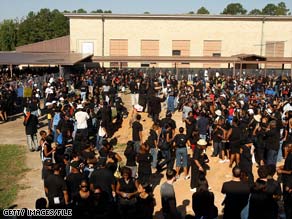
The judge overseeing the criminal cases for the remaining Jena Six defendants was removed against his will Friday for making questionable remarks about the teenagers, the Associated Press reported.
Judge J.P. Mauffray Jr. had acknowledged calling the teens "trouble makers" and "a violent bunch" but insisted he could be impartial. Defense attorneys disagreed and asked that he be removed.
The defense attorneys said the judge "had made numerous statements on numerous occasions" which indicated he had decided that at least one of the defendants was already guilty, CNN reported.
"Indeed, Judge Mauffrey has expressed his belief generally that Jesse Ray [Beard] and his African-American friends are guilty, not only of the misconduct alleged in this matter, but of several other acts of misconduct as well," according to court documents filed in the case.
Jesse Ray Beard is one of six Jena High School students arrested and initially charged with attempted murder and conspiracy to commit murder in connection with a December 4, 2006, attack on fellow student Justin Barker, who is white.
Although the charges were later reduced, the cases became a national battleground for racial tensions, drawing large protests for civil rights like the one pictured above on September 20, 2007.
Earlier this year, Jena's Martin Luther King, Jr. Day celebration was the center of a standoff between a white supremacist group and an equal opportunity group.
Attorney Dale Hickman represents Bryant Purvis, another of the Jena Six, and said it was good news that Judge Mauffrey had been taken off the cases.
Hickman said Mauffrey viewed the youths as "six thugs" and not as individuals.
Wire services contributed to this report.
Source: The Raw Story
RAW STORY
Published: Friday August 1, 2008
The judge overseeing the criminal cases for the remaining Jena Six defendants was removed against his will Friday for making questionable remarks about the teenagers, the Associated Press reported.
Judge J.P. Mauffray Jr. had acknowledged calling the teens "trouble makers" and "a violent bunch" but insisted he could be impartial. Defense attorneys disagreed and asked that he be removed.
The defense attorneys said the judge "had made numerous statements on numerous occasions" which indicated he had decided that at least one of the defendants was already guilty, CNN reported.
"Indeed, Judge Mauffrey has expressed his belief generally that Jesse Ray [Beard] and his African-American friends are guilty, not only of the misconduct alleged in this matter, but of several other acts of misconduct as well," according to court documents filed in the case.
Jesse Ray Beard is one of six Jena High School students arrested and initially charged with attempted murder and conspiracy to commit murder in connection with a December 4, 2006, attack on fellow student Justin Barker, who is white.
Although the charges were later reduced, the cases became a national battleground for racial tensions, drawing large protests for civil rights like the one pictured above on September 20, 2007.
Earlier this year, Jena's Martin Luther King, Jr. Day celebration was the center of a standoff between a white supremacist group and an equal opportunity group.
Attorney Dale Hickman represents Bryant Purvis, another of the Jena Six, and said it was good news that Judge Mauffrey had been taken off the cases.
Hickman said Mauffrey viewed the youths as "six thugs" and not as individuals.
Wire services contributed to this report.
Source: The Raw Story
Wednesday, July 30, 2008
Fremont Council Says No to Illegal Immigration Measure
Fremont, Neb.
Posted: 9:52 PM Jul 29, 2008
Last Updated: 9:29 AM Jul 30, 2008
Reporter: Alicia Myers
Email Address: alicia.myers@kolnkgin.com
Fremont Immigration Hearing
Nearly 1,000 people turned out in Fremont Tuesday night, voicing their opinions on a proposed illegal immigrant ban.
The Fremont city council has spent the past few weeks weighing in on the issue that could outlaw things like hiring or renting to illegal immigrants.
Fremont business leaders say they worry a new ordinance targeting illegal immigration could hurt the community. That is exactly how hundreds of residents feel.
Some council members say it is an issue that needs to be looked at for the sake of some supportive residents.
The city council wasn't supposed to vote until the end of August but decided to vote Tuesday night. They were deadlocked at 4-4 before Mayor Don "Skip" Edwards voted against the ordinance.
Testimony took more than three hours. Near the beginning of the testimonies, the length of the line into Fremont High School's auditorium was something you'd normally see waiting outside a headliner concert. Instead, the line was full of people fighting for their rights, as well as their community's well-being, at Fremont's Tuesday evening city council immigration hearing.
"We're here in peace. We want to show them that we want to live in this community," said Gabby Ayala, Fremont resident.
Ayala has been a legal U.S. citizen for many years, but when she came to the states, she said it was a different story.
"I was an illegal immigrant," Ayala said. "I know it's hard. It's scary to go out, and think that people are looking at you because they're wondering if you're legal or not. Thankfully now, I'm a U.S. citizen, and that's why I'm supporting the illegal immigration."
Ayala said the ordinance would tear the city apart, by making it illegal to harbor, hire, or rent to any illegal immigrants.
City Council Chair, Gary Bolton, said while he is not a fan of the local city ordinance, something at the federal level needs to be done.
"Without a doubt, nearly everyone, whether you're in favor of the ordinance or opposed to the ordinance, I think there are those that feel we have an immigration problem in this country," Bolton said.
"I think the country needs to be legalized. Everybody that's supposed to be here should be here, and the rest should leave," said Al Knoell, Fremont resident.
Those opposed say an ordinance like this could divide the city in a negative way.
"We're also concerned that the ordinance would lead to increased discrimination to all immigrants, not just undocumented immigrants, but all immigrants as well as other minorities," said Norm Pflanz, Nebraska Appleseed.
As hundreds gathered, sharing their opinions, Ayala hoped for the best for her community.
"I hope the government does something, and accomplishes something, and gives everybody the chance to become legal in this country," said Ayala.
KOLN KGIN
Posted: 9:52 PM Jul 29, 2008
Last Updated: 9:29 AM Jul 30, 2008
Reporter: Alicia Myers
Email Address: alicia.myers@kolnkgin.com
Fremont Immigration Hearing
Nearly 1,000 people turned out in Fremont Tuesday night, voicing their opinions on a proposed illegal immigrant ban.
The Fremont city council has spent the past few weeks weighing in on the issue that could outlaw things like hiring or renting to illegal immigrants.
Fremont business leaders say they worry a new ordinance targeting illegal immigration could hurt the community. That is exactly how hundreds of residents feel.
Some council members say it is an issue that needs to be looked at for the sake of some supportive residents.
The city council wasn't supposed to vote until the end of August but decided to vote Tuesday night. They were deadlocked at 4-4 before Mayor Don "Skip" Edwards voted against the ordinance.
Testimony took more than three hours. Near the beginning of the testimonies, the length of the line into Fremont High School's auditorium was something you'd normally see waiting outside a headliner concert. Instead, the line was full of people fighting for their rights, as well as their community's well-being, at Fremont's Tuesday evening city council immigration hearing.
"We're here in peace. We want to show them that we want to live in this community," said Gabby Ayala, Fremont resident.
Ayala has been a legal U.S. citizen for many years, but when she came to the states, she said it was a different story.
"I was an illegal immigrant," Ayala said. "I know it's hard. It's scary to go out, and think that people are looking at you because they're wondering if you're legal or not. Thankfully now, I'm a U.S. citizen, and that's why I'm supporting the illegal immigration."
Ayala said the ordinance would tear the city apart, by making it illegal to harbor, hire, or rent to any illegal immigrants.
City Council Chair, Gary Bolton, said while he is not a fan of the local city ordinance, something at the federal level needs to be done.
"Without a doubt, nearly everyone, whether you're in favor of the ordinance or opposed to the ordinance, I think there are those that feel we have an immigration problem in this country," Bolton said.
"I think the country needs to be legalized. Everybody that's supposed to be here should be here, and the rest should leave," said Al Knoell, Fremont resident.
Those opposed say an ordinance like this could divide the city in a negative way.
"We're also concerned that the ordinance would lead to increased discrimination to all immigrants, not just undocumented immigrants, but all immigrants as well as other minorities," said Norm Pflanz, Nebraska Appleseed.
As hundreds gathered, sharing their opinions, Ayala hoped for the best for her community.
"I hope the government does something, and accomplishes something, and gives everybody the chance to become legal in this country," said Ayala.
KOLN KGIN
Immigrant problem is bigger than Fremont, mayor says
BY JOHN FERAK AND CINDY GONZALEZ
WORLD-HERALD STAFF WRITERS
Mayor receives standing ovation: Click here to watch the video
FREMONT, Neb. - Five-term Mayor Donald "Skip" Edwards says illegal immigration is a huge problem, but he doesn't think his small city is the place to try to solve an issue facing the entire country.
Fremont police watched over the crowd during the hearing.
At about 11:30 p.m. Tuesday, Edwards cast the pivotal vote to break a 4-4 Fremont City Council tie and defeat a proposed city ordinance aimed at driving away illegal immigrants by punishing landlords and businesses who rented to and hired them.
"Casting the vote was very emotional for me. I sincerely mean that we do have a problem in this country with illegal immigration," Edwards, 69, said today.
The vote followed a hearing that drew more than 1,000 people to the Fremont High School auditorium, where the council heard impassioned testimony for and against the proposal.
Edwards said that he strongly opposed illegal immigration and that the vote had weighed heavily on him. But he made his decision after consulting with several law firms.
"Trying to enforce this type of ordinance would be very expensive, hundreds of thousands of dollars, possibly millions," he said. "I am of the opinion this is a federal law. I vote no."
Boos from an audience that shrank as the night wore on were drowned out by a standing ovation cheering Edwards' vote.
When the tense meeting ended, the slender, gray-haired Edwards sat for several minutes in a classroom, recuperating from the emotionally charged session that had lasted nearly five hours.
Some City Council members and other city officials offered him words of comfort, encouragement and congratulations.
Afterward, the mayor and council members received police escorts to their cars. Edwards said today that he isn't fearful for his safety because of the vote.
Fremont, a town of about 25,000 northwest of Omaha, has seen its Latino population increase in recent years due largely to the presence of meatpacking jobs. The Latino population in the 4,600-student Fremont Public Schools has been estimated at 15 percent.
Landlords leasing to illegal immigrants would have faced a $100 fine. Under special licensing requirements - which would have applied to every renter regardless of heritage - an occupant would have had to buy a $5 occupancy license, issued only after local police had verified immigration status.
The crowd at Tuesday night's council meeting came from Omaha, Lincoln, Columbus and elsewhere in Nebraska to speak on what would be the state's first city-driven proposal to force out illegal immigrants.
The proposal had elevated tensions, which was reflected by a heavy law enforcement presence - some 50 officers from the Fremont and Omaha Police Departments, the Nebraska State Patrol and the Dodge County Sheriff's Office - and strict procedures.
The auditorium was swept by a bomb-sniffing dog before the public filed in two lines past portable and hand-held metal detectors.
Those testifying lined up at two separate microphones according to their position on the issue and took turns speaking for and against, with comments limited to three minutes each.
More than a dozen officers were scattered throughout the auditorium and, at times, scolded people if they applauded or otherwise tried to react to a speaker.
Except for an elderly man wearing a veterans cap - who was kicked out by police after he yelled, "Bring it on!" - the hearing was generally orderly.
People began arriving before 5 p.m., and the last of 75 speakers finished about 11 p.m.
Councilman Gary Bolton, who voted against the ordinance, said he, too, was frustrated with the failure of federal officials to enforce immigration laws. But he said the ordinance would be costly to the city.
Councilman Scott Getzschman said many of his constituents asked to put an end to the proposal and the heightened tensions it had raised in Fremont.
The debate also brought e-mails, letters and talk show requests from across the country.
Also voting against the ordinance were council members John Anderson and Jon Gilfry.
Voting in favor, without comment, were Charlie Janssen, Mary Marsh and Scott Schaller. Bob Warner, who proposed the ordinance, said he believed the ordinance could be enforced.
During the hearing, supporters of the ordinance cited crime, disease and abuse of public assistance as reasons that the City Council should pass the ordinance.
"Yes, I'm frustrated," said Susan Smith of Fremont, contending that illegal immigrants are the main cause of disease coming into the United States.
Robert Hollister of Omaha wore a T-shirt that said, "Illegal aliens harm U.S. economy and ecology," and his wife wore one that said, 'Where's the fence?"
"The federal government's dropped the ball," Robert Hollister told the council. "The Unicameral's dropped the ball."
John Wiegert, a Fremont resident who teaches in Yutan, said the ordinance was needed to alleviate a burden on schools and emergency rooms.
"Racism has nothing to do with this ordinance," Wiegert said. "This ordinance is about what is legal and what is illegal. If the federal government is not going to watch out for us, then we need to watch out for ourselves."
Others questioned why their city should pay to defend an ordinance that attorneys have told the council is unconstitutional and unenforceable.
Several said that they were embarrassed by the proposal and that it made Fremont look intolerant.
"We do not feel this ordinance will benefit Fremont in any way," said Christy Fiala, a Fremont native who said she represented a coalition of local churches, schools and social service agencies. "Rather it will negatively impact Fremont."
Severiano Franco of Lincoln said the council could distinguish itself by enacting the ordinance. "You'll be No. 1," he said, "You'll be the biggest bigoted, racist city in the state."
Stacey Escobedo of Fremont said she and her husband have spent $7,000 and seven years trying to remedy his immigration status. Her husband, who entered the United States on a legal visa that has since expired, has adopted her children.
"I'm very irritated," she said. "This ordinance is disgusting."
Before the mayor's tiebreaking vote, Fremont City Attorney Dean Skokan informed everyone that by law, Edwards could abstain from voting and effectively kill the ordinance, which required a majority vote to pass.
Edwards said that he had a sense heading into the meeting that council might deadlock.
"I didn't know absolutely for sure that it would wind up 4-to-4, but I knew in my mind there might be a chance. Yes, it was unusual, because our council usually has a pretty good consensus on issues . . . But you just get those gut feelings," he said today.
"It was a tough issue and a tough decision to make. But I always pray about it and try to look at the whole picture and how it will affect Fremont," he said.
Edwards, now in his 20th year as mayor, said he wasn't concerned about political fallout.
"I never pay attention to that," he said. "I love this community dearly, and that's I why I continue to do this job."
Getzschman said Edwards had showed true courage and leadership by casting a vote when he wasn't required to do so.
"He's a very grounded person, and Skip is one of the most dedicated civic leaders in Fremont. He literally eats, drinks and sleeps Fremont, Nebraska," the council member said. "He has a true passion for his job. He prayed, he soul-searched and made a decision that he felt in his own mind was in the best interest of Fremont."
World-Herald Video:
• Vote on the ordinance
http://content.omaha.com/media/maps/video/072908vote
• Council member Bob Warner defends the measure
http://content.omaha.com/media/maps/video/072908warner
• Public input during the hearing
http://content.omaha.com/media/maps/video/072908kcpublicspeaks
• Differing views outside the hearing
http://content.omaha.com/media/maps/video/072908fremont
Source: Omaha
WORLD-HERALD STAFF WRITERS
Mayor receives standing ovation: Click here to watch the video
FREMONT, Neb. - Five-term Mayor Donald "Skip" Edwards says illegal immigration is a huge problem, but he doesn't think his small city is the place to try to solve an issue facing the entire country.
Fremont police watched over the crowd during the hearing.
At about 11:30 p.m. Tuesday, Edwards cast the pivotal vote to break a 4-4 Fremont City Council tie and defeat a proposed city ordinance aimed at driving away illegal immigrants by punishing landlords and businesses who rented to and hired them.
"Casting the vote was very emotional for me. I sincerely mean that we do have a problem in this country with illegal immigration," Edwards, 69, said today.
The vote followed a hearing that drew more than 1,000 people to the Fremont High School auditorium, where the council heard impassioned testimony for and against the proposal.
Edwards said that he strongly opposed illegal immigration and that the vote had weighed heavily on him. But he made his decision after consulting with several law firms.
"Trying to enforce this type of ordinance would be very expensive, hundreds of thousands of dollars, possibly millions," he said. "I am of the opinion this is a federal law. I vote no."
Boos from an audience that shrank as the night wore on were drowned out by a standing ovation cheering Edwards' vote.
When the tense meeting ended, the slender, gray-haired Edwards sat for several minutes in a classroom, recuperating from the emotionally charged session that had lasted nearly five hours.
Some City Council members and other city officials offered him words of comfort, encouragement and congratulations.
Afterward, the mayor and council members received police escorts to their cars. Edwards said today that he isn't fearful for his safety because of the vote.
Fremont, a town of about 25,000 northwest of Omaha, has seen its Latino population increase in recent years due largely to the presence of meatpacking jobs. The Latino population in the 4,600-student Fremont Public Schools has been estimated at 15 percent.
Landlords leasing to illegal immigrants would have faced a $100 fine. Under special licensing requirements - which would have applied to every renter regardless of heritage - an occupant would have had to buy a $5 occupancy license, issued only after local police had verified immigration status.
The crowd at Tuesday night's council meeting came from Omaha, Lincoln, Columbus and elsewhere in Nebraska to speak on what would be the state's first city-driven proposal to force out illegal immigrants.
The proposal had elevated tensions, which was reflected by a heavy law enforcement presence - some 50 officers from the Fremont and Omaha Police Departments, the Nebraska State Patrol and the Dodge County Sheriff's Office - and strict procedures.
The auditorium was swept by a bomb-sniffing dog before the public filed in two lines past portable and hand-held metal detectors.
Those testifying lined up at two separate microphones according to their position on the issue and took turns speaking for and against, with comments limited to three minutes each.
More than a dozen officers were scattered throughout the auditorium and, at times, scolded people if they applauded or otherwise tried to react to a speaker.
Except for an elderly man wearing a veterans cap - who was kicked out by police after he yelled, "Bring it on!" - the hearing was generally orderly.
People began arriving before 5 p.m., and the last of 75 speakers finished about 11 p.m.
Councilman Gary Bolton, who voted against the ordinance, said he, too, was frustrated with the failure of federal officials to enforce immigration laws. But he said the ordinance would be costly to the city.
Councilman Scott Getzschman said many of his constituents asked to put an end to the proposal and the heightened tensions it had raised in Fremont.
The debate also brought e-mails, letters and talk show requests from across the country.
Also voting against the ordinance were council members John Anderson and Jon Gilfry.
Voting in favor, without comment, were Charlie Janssen, Mary Marsh and Scott Schaller. Bob Warner, who proposed the ordinance, said he believed the ordinance could be enforced.
During the hearing, supporters of the ordinance cited crime, disease and abuse of public assistance as reasons that the City Council should pass the ordinance.
"Yes, I'm frustrated," said Susan Smith of Fremont, contending that illegal immigrants are the main cause of disease coming into the United States.
Robert Hollister of Omaha wore a T-shirt that said, "Illegal aliens harm U.S. economy and ecology," and his wife wore one that said, 'Where's the fence?"
"The federal government's dropped the ball," Robert Hollister told the council. "The Unicameral's dropped the ball."
John Wiegert, a Fremont resident who teaches in Yutan, said the ordinance was needed to alleviate a burden on schools and emergency rooms.
"Racism has nothing to do with this ordinance," Wiegert said. "This ordinance is about what is legal and what is illegal. If the federal government is not going to watch out for us, then we need to watch out for ourselves."
Others questioned why their city should pay to defend an ordinance that attorneys have told the council is unconstitutional and unenforceable.
Several said that they were embarrassed by the proposal and that it made Fremont look intolerant.
"We do not feel this ordinance will benefit Fremont in any way," said Christy Fiala, a Fremont native who said she represented a coalition of local churches, schools and social service agencies. "Rather it will negatively impact Fremont."
Severiano Franco of Lincoln said the council could distinguish itself by enacting the ordinance. "You'll be No. 1," he said, "You'll be the biggest bigoted, racist city in the state."
Stacey Escobedo of Fremont said she and her husband have spent $7,000 and seven years trying to remedy his immigration status. Her husband, who entered the United States on a legal visa that has since expired, has adopted her children.
"I'm very irritated," she said. "This ordinance is disgusting."
Before the mayor's tiebreaking vote, Fremont City Attorney Dean Skokan informed everyone that by law, Edwards could abstain from voting and effectively kill the ordinance, which required a majority vote to pass.
Edwards said that he had a sense heading into the meeting that council might deadlock.
"I didn't know absolutely for sure that it would wind up 4-to-4, but I knew in my mind there might be a chance. Yes, it was unusual, because our council usually has a pretty good consensus on issues . . . But you just get those gut feelings," he said today.
"It was a tough issue and a tough decision to make. But I always pray about it and try to look at the whole picture and how it will affect Fremont," he said.
Edwards, now in his 20th year as mayor, said he wasn't concerned about political fallout.
"I never pay attention to that," he said. "I love this community dearly, and that's I why I continue to do this job."
Getzschman said Edwards had showed true courage and leadership by casting a vote when he wasn't required to do so.
"He's a very grounded person, and Skip is one of the most dedicated civic leaders in Fremont. He literally eats, drinks and sleeps Fremont, Nebraska," the council member said. "He has a true passion for his job. He prayed, he soul-searched and made a decision that he felt in his own mind was in the best interest of Fremont."
World-Herald Video:
• Vote on the ordinance
http://content.omaha.com/media/maps/video/072908vote
• Council member Bob Warner defends the measure
http://content.omaha.com/media/maps/video/072908warner
• Public input during the hearing
http://content.omaha.com/media/maps/video/072908kcpublicspeaks
• Differing views outside the hearing
http://content.omaha.com/media/maps/video/072908fremont
Source: Omaha
Right-Wing Pathologies Revealed After Adkisson Shooting at Unitarian Church
By John Dolan, AlterNet. Posted July 29, 2008.
When Free Republic forum posters learned that the gunman was from their own demographic, out came the conservative madness.
A classic drama full of hatred, ignorance and irony played out this week in the forum section of right-wing Web site Free Republic, as "Freepers" tried to make sense of a church shooting in Tennessee that killed two parishioners and wounded many others. The grotesque irony of the FR discussions is that, after early posters had indulged all their bigoted guesses about the identity of the killer, they found out the gunman was actually straight out of their own demographic: a 59-year-old white man named Jim Adkisson, who left a four-page letter ranting against liberals, was known by his acquaintances to hate "blacks, gays and anyone who was different from him," left a pile of books by O'Reilly, Savage and Hannity behind in his car, and even wore a red-white-and-blue shirt to his church killing spree.
It's morbidly fascinating to watch the FR threads as the posters wriggle and bluster to try to accommodate this most inconvenient truth. And if you have the stomach to read them, you can learn a lot (perhaps more than you'd like) about the pathology of the contemporary American Right. For myself -- and I realize this will be the most profound heresy to progressives committed to the populist line -- reading these posts is a timely slap in the face, a painful reminder that maybe, just maybe, heartland Americans aren't such wonderful people at all. What you see in these posts is the oldest, deepest and meanest strain in American culture: the Ulster America founded by violent sectarians who moved westward again and again, from Scotland to Northern Ireland and then to the southern United States, then again westward into the American continent, to find a place where they could hone their hair-trigger intolerance without fear of interference from warmer, more humorous people. But that's me, and I'm often accused of "cynicism," whatever that means. At any rate, I'll present a little background on the site and then discuss a few of the posts. Make of them what you will.
For those who want to do their own analyses before reading on, here are the Web addresses of the three FR threads discussing the Tennessee shootings, in the order they appeared:
http://www.freerepublic.com/focus/search?;s=tennessee%20church
http://www.freerepublic.com/focus/f-news/2052204/posts
http://www.freerepublic.com/focus/f-news/2052590/posts
For those unfamiliar with online right-wing culture, Free Republic is a far-right Web site established in 1996. It soon found a huge, loyal audience among the right wing's most rabid, ignorant and openly fascistic voices -- or as FR calls them, "grassroots conservatives." Even other right-wing Web sites shun FR, and you'll often observe posters to these sites worrying, when online discussions become openly racist or fascistic, that they're becoming too much like "the Freepers," as FR's ranting posters proudly call themselves.
The same hatred of "liberals" that drove the Tennessee killer is on display, with unconscious irony, in the house advertisement appearing at the top of one of the forums on the church shooting. A bald eagle stands before an American flag, with the caption, "Driving liberals crazy and having fun doing it!"
The first posts reacting to the church shooting are smug gloats. Many posters were absolutely certain that the gunman would turn out to be a Muslim:
Source: Alternet
When Free Republic forum posters learned that the gunman was from their own demographic, out came the conservative madness.
A classic drama full of hatred, ignorance and irony played out this week in the forum section of right-wing Web site Free Republic, as "Freepers" tried to make sense of a church shooting in Tennessee that killed two parishioners and wounded many others. The grotesque irony of the FR discussions is that, after early posters had indulged all their bigoted guesses about the identity of the killer, they found out the gunman was actually straight out of their own demographic: a 59-year-old white man named Jim Adkisson, who left a four-page letter ranting against liberals, was known by his acquaintances to hate "blacks, gays and anyone who was different from him," left a pile of books by O'Reilly, Savage and Hannity behind in his car, and even wore a red-white-and-blue shirt to his church killing spree.
It's morbidly fascinating to watch the FR threads as the posters wriggle and bluster to try to accommodate this most inconvenient truth. And if you have the stomach to read them, you can learn a lot (perhaps more than you'd like) about the pathology of the contemporary American Right. For myself -- and I realize this will be the most profound heresy to progressives committed to the populist line -- reading these posts is a timely slap in the face, a painful reminder that maybe, just maybe, heartland Americans aren't such wonderful people at all. What you see in these posts is the oldest, deepest and meanest strain in American culture: the Ulster America founded by violent sectarians who moved westward again and again, from Scotland to Northern Ireland and then to the southern United States, then again westward into the American continent, to find a place where they could hone their hair-trigger intolerance without fear of interference from warmer, more humorous people. But that's me, and I'm often accused of "cynicism," whatever that means. At any rate, I'll present a little background on the site and then discuss a few of the posts. Make of them what you will.
For those who want to do their own analyses before reading on, here are the Web addresses of the three FR threads discussing the Tennessee shootings, in the order they appeared:
http://www.freerepublic.com/focus/search?;s=tennessee%20church
http://www.freerepublic.com/focus/f-news/2052204/posts
http://www.freerepublic.com/focus/f-news/2052590/posts
For those unfamiliar with online right-wing culture, Free Republic is a far-right Web site established in 1996. It soon found a huge, loyal audience among the right wing's most rabid, ignorant and openly fascistic voices -- or as FR calls them, "grassroots conservatives." Even other right-wing Web sites shun FR, and you'll often observe posters to these sites worrying, when online discussions become openly racist or fascistic, that they're becoming too much like "the Freepers," as FR's ranting posters proudly call themselves.
The same hatred of "liberals" that drove the Tennessee killer is on display, with unconscious irony, in the house advertisement appearing at the top of one of the forums on the church shooting. A bald eagle stands before an American flag, with the caption, "Driving liberals crazy and having fun doing it!"
The first posts reacting to the church shooting are smug gloats. Many posters were absolutely certain that the gunman would turn out to be a Muslim:
Source: Alternet
Lawmakers to push for U.S. apology for slavery
By Wendy Koch, USA TODAY

Five states did something over the past 12 months that no state had done before: expressed regret or apologized for slavery.
This year, Congress, which meets in a Capitol built partly by slaves, will consider issuing its own apology.
"We've seen states step forward on this," says Sen. Tom Harkin, D-Iowa, citing the resolutions of Virginia, Maryland, North Carolina, Alabama and New Jersey. "I'm really shocked, just shocked" that the federal government hasn't apologized. "It's time to do so."
Harkin says he and Sen. Sam Brownback R-Kan., will propose as early as March an apology not only for slavery but for subsequent "Jim Crow" laws that furthered racial segregation. So far, they have 14 Senate backers, including Democratic presidential candidates Hillary Rodham Clinton and Barack Obama. A similar House measure introduced last year has 120 co-sponsors.
"I think 2008 will be the year," says Rep. Steve Cohen, D-Tenn. He says an apology could begin a dialogue about race that Obama could continue as the nation's first black president.
"The success of the Obama candidacy underscores the irrelevance of an apology" because it shows "enormous progress" in race relations, says Roger Clegg of the Center for Equal Opportunity, a conservative group that describes itself as opposed to racial preferences. "Haven't we already moved beyond it?"
Congress has apologized before, but not for slavery.
It apologized to Japanese-Americans in 1988 for holding them in camps during World War II and gave each survivor $20,000. In 1993, Congress apologized to native Hawaiians for the overthrow of their kingdom a century earlier. In 2005, the Senate apologized for not enacting anti-lynching legislation.
The Senate has no record of any prior effort to apologize for slavery. In the House of Representatives, Tony Hall, an Ohio Democrat, proposed one in 1997 and Rep. John Conyers, D- Mich., has tried since 1989 to pass a bill that would create a commission to study slavery's impact and possible remedies, including reparations and cash payments.
Apologies are controversial because they could lead to reparations.
They "carry weight" as a step toward racial healing and don't have to "open the door" to reparations, says Carol Swain, professor of political science and law at Vanderbilt University.
Other proponents say an apology should lead to remedies.
"A mere apology doesn't do anything for me," says state Rep. Talibdin El-Amin, a Democrat who is lobbying for such a resolution in Missouri.
An apology is a necessary first step because it recognizes a wrongdoing, says Hilary Shelton of the NAACP.
He says it's "hollow," though, unless it leads to a remedy for African-Americans, who still suffer economically and educationally from the aftereffects of slavery and segregation.
Remedies don't have to be monetary payments but could be government programs to help the disadvantaged, Cohen says.
An apology is counterproductive, Clegg says. "It taps into white guilt and helps perpetuate social programs the civil rights establishment likes, such as racial preferences and ultimately reparations," he says.
Clegg says that an apology serves "no legitimate purpose since the villains and victims are long since deceased" and that such an action could instead be divisive and "keep racial wounds alive."
The state apologies have not given a boost to the reparations movement, says Ronald Walters, author of a new book titled The Price of Racial Reconciliation.
Last February, Virginia became the first state to issue a form of apology, expressing "profound regret," as did Maryland lawmakers a month later. The three states that followed expressed regret and apologized.
Alabama and New Jersey added language saying the apology cannot be used to sue the state.
The House proposal does not include such a disclaimer, but the Senate one does, saying its apology cannot be the basis for claims against the United States.
Harkin says his proposal does not address reparations.
"We're just apologizing," he says. "You can't undo the past, but you can recognize a wrong was done."
Source: USA Today
Five states did something over the past 12 months that no state had done before: expressed regret or apologized for slavery.
This year, Congress, which meets in a Capitol built partly by slaves, will consider issuing its own apology.
"We've seen states step forward on this," says Sen. Tom Harkin, D-Iowa, citing the resolutions of Virginia, Maryland, North Carolina, Alabama and New Jersey. "I'm really shocked, just shocked" that the federal government hasn't apologized. "It's time to do so."
Harkin says he and Sen. Sam Brownback R-Kan., will propose as early as March an apology not only for slavery but for subsequent "Jim Crow" laws that furthered racial segregation. So far, they have 14 Senate backers, including Democratic presidential candidates Hillary Rodham Clinton and Barack Obama. A similar House measure introduced last year has 120 co-sponsors.
"I think 2008 will be the year," says Rep. Steve Cohen, D-Tenn. He says an apology could begin a dialogue about race that Obama could continue as the nation's first black president.
"The success of the Obama candidacy underscores the irrelevance of an apology" because it shows "enormous progress" in race relations, says Roger Clegg of the Center for Equal Opportunity, a conservative group that describes itself as opposed to racial preferences. "Haven't we already moved beyond it?"
Congress has apologized before, but not for slavery.
It apologized to Japanese-Americans in 1988 for holding them in camps during World War II and gave each survivor $20,000. In 1993, Congress apologized to native Hawaiians for the overthrow of their kingdom a century earlier. In 2005, the Senate apologized for not enacting anti-lynching legislation.
The Senate has no record of any prior effort to apologize for slavery. In the House of Representatives, Tony Hall, an Ohio Democrat, proposed one in 1997 and Rep. John Conyers, D- Mich., has tried since 1989 to pass a bill that would create a commission to study slavery's impact and possible remedies, including reparations and cash payments.
Apologies are controversial because they could lead to reparations.
They "carry weight" as a step toward racial healing and don't have to "open the door" to reparations, says Carol Swain, professor of political science and law at Vanderbilt University.
Other proponents say an apology should lead to remedies.
"A mere apology doesn't do anything for me," says state Rep. Talibdin El-Amin, a Democrat who is lobbying for such a resolution in Missouri.
An apology is a necessary first step because it recognizes a wrongdoing, says Hilary Shelton of the NAACP.
He says it's "hollow," though, unless it leads to a remedy for African-Americans, who still suffer economically and educationally from the aftereffects of slavery and segregation.
Remedies don't have to be monetary payments but could be government programs to help the disadvantaged, Cohen says.
An apology is counterproductive, Clegg says. "It taps into white guilt and helps perpetuate social programs the civil rights establishment likes, such as racial preferences and ultimately reparations," he says.
Clegg says that an apology serves "no legitimate purpose since the villains and victims are long since deceased" and that such an action could instead be divisive and "keep racial wounds alive."
The state apologies have not given a boost to the reparations movement, says Ronald Walters, author of a new book titled The Price of Racial Reconciliation.
Last February, Virginia became the first state to issue a form of apology, expressing "profound regret," as did Maryland lawmakers a month later. The three states that followed expressed regret and apologized.
Alabama and New Jersey added language saying the apology cannot be used to sue the state.
The House proposal does not include such a disclaimer, but the Senate one does, saying its apology cannot be the basis for claims against the United States.
Harkin says his proposal does not address reparations.
"We're just apologizing," he says. "You can't undo the past, but you can recognize a wrong was done."
Source: USA Today
Subscribe to:
Posts (Atom)

 Posts
Posts


